
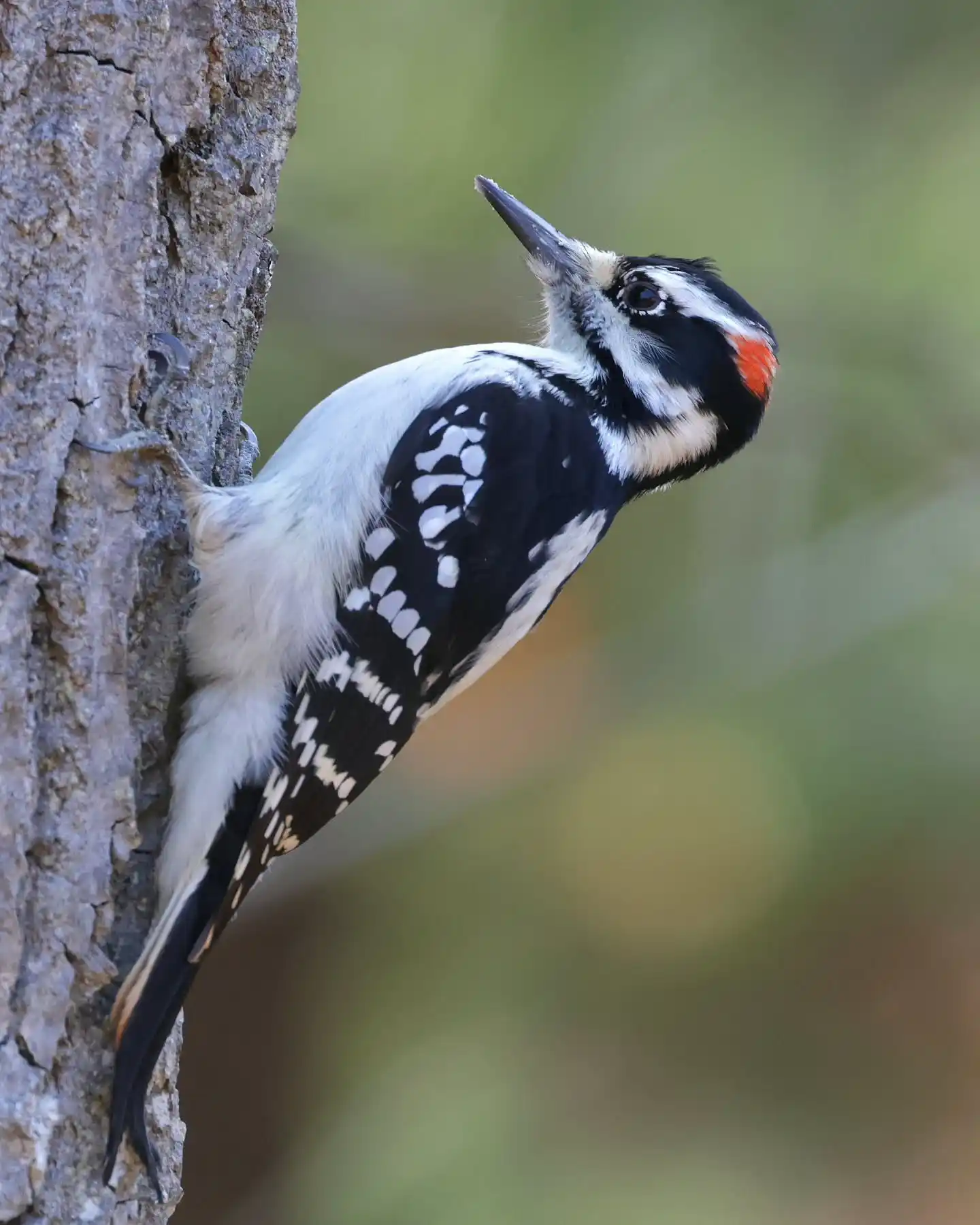
A flash of red in a tree can belong to a cardinal, finch, tanager, or one of several woodpeckers. Some birds have an entirely red head, while others show only a small patch on the crown or back of the neck.
Sex and season matter too. In many species, only adult males have red feathers. This guide covers 18 birds with red heads in North America and explains the easiest way to identify each one.
Red-Headed Birds Identification Chart
| Bird | Head marking | Size | Common location |
| Northern Cardinal | Entire head red on male | 8.3–9.1 in | Eastern backyards |
| House Finch | Red forehead and face on male | 5.1–5.5 in | Towns and feeders |
| Purple Finch | Raspberry-red head on male | 4.7–6.3 in | Northern forests |
| Cassin’s Finch | Bright red crown on male | 6.3 in | Western mountains |
| Red Crossbill | Red head and body on male | 5.5–7.9 in | Coniferous forests |
| Pine Grosbeak | Rosy-red head on male | 7.9–10 in | Northern forests |
| Common Redpoll | Small red crown | 4.5–5.5 in | Northern fields |
| Summer Tanager | Entire head and body red on male | 6.7 in | Southern forests |
| Scarlet Tanager | Bright red head on male | 6.3–6.7 in | Eastern forests |
| Vermilion Flycatcher | Red crown and underparts on male | 5.1–5.5 in | Southwestern open country |
| Ruby-crowned Kinglet | Hidden red crown on male | 3.5–4.3 in | Woodlands and shrubs |
| Red-headed Woodpecker | Entire head red | 7.5–9.1 in | Open woodlands |
| Red-bellied Woodpecker | Red crown and nape on male | 9.1–10.6 in | Eastern forests |
| Pileated Woodpecker | Large red crest | 15.8–19.3 in | Mature forests |
| Downy Woodpecker | Small red patch on male | 5.5–6.7 in | Backyards and woods |
| Hairy Woodpecker | Red patch behind crown on male | 7.1–10.2 in | Mature forests |
| Yellow-bellied Sapsucker | Red crown on adults | 7.1–8.7 in | Eastern woodlands |
| Acorn Woodpecker | Red crown | 7.5–9.1 in | Western oak woodlands |
1. Northern Cardinal
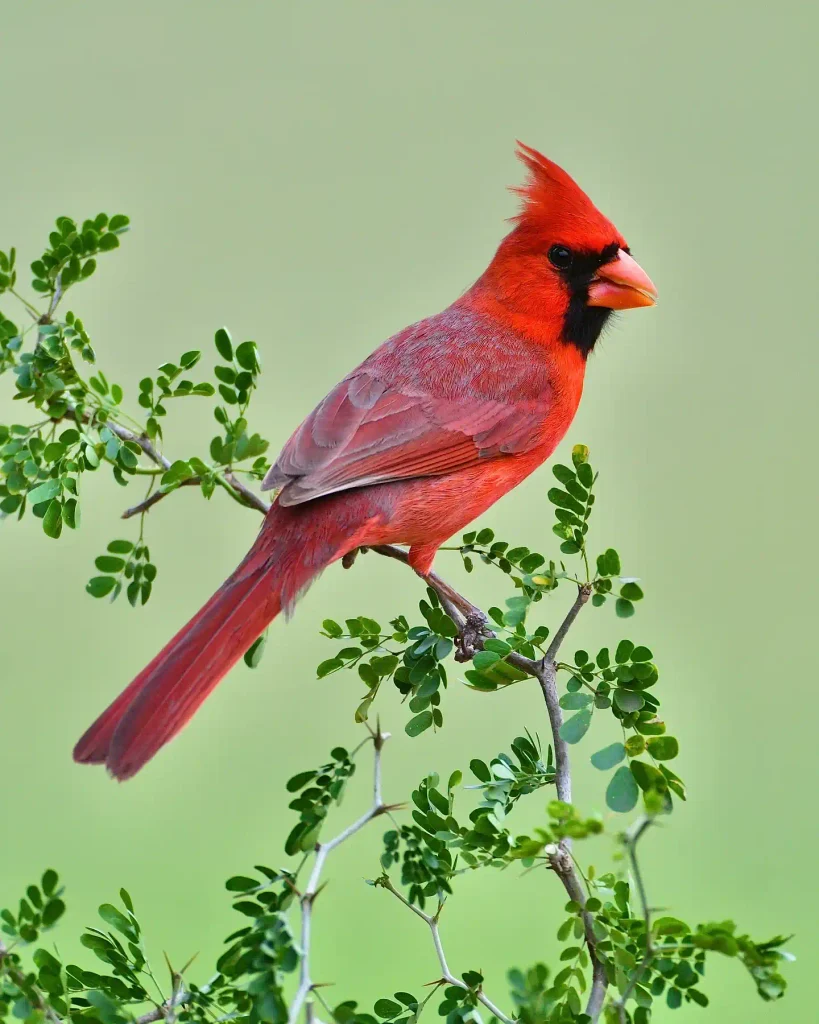
The male Northern Cardinal is one of the easiest red-headed birds to identify. Its head and body are bright red, with a pointed crest, black face, and thick orange-red bill. Females are mostly warm brown but have red on the wings, tail, and crest.
Northern Cardinals remain in the same general area throughout the year. They frequently visit feeders for sunflower and safflower seeds. Their clear whistles can be heard from shrubs, woodland edges, gardens, and suburban yards.
- Scientific name: Cardinalis cardinalis
- Length: 8.3–9.1 inches
- Range: Eastern, central, and southwestern United States
- Best ID clue: Red crest and black facial mask
2. House Finch

Male House Finches have red across the forehead, eyebrow, throat, and upper chest. Their back and wings remain brown, while the pale belly has heavy brown streaks. Females have no red and are brown with blurry streaking below.
These finches are common around houses, shopping centers, farms, and backyard feeders. Their red color can vary from deep red to orange or even yellow, depending partly on pigments obtained from food during molt.
- Scientific name: Haemorhous mexicanus
- Length: 5.1–5.5 inches
- Range: Most of the United States, southern Canada, and Mexico
- Best ID clue: Red face with heavily streaked sides
3. Purple Finch

Despite its name, the male Purple Finch is raspberry red rather than purple. Red covers much of the head, breast, and back, giving the bird a dipped-in-berry-juice appearance. Its belly is paler and usually has less heavy streaking than a male House Finch.
Females are brown with strong facial markings and crisp streaks. Purple Finches live in northern coniferous and mixed forests. In winter, they may appear farther south at feeders when cone and seed crops are poor.
- Scientific name: Haemorhous purpureus
- Length: 4.7–6.3 inches
- Range: Canada, northeastern United States, and Pacific Coast
- Best ID clue: Raspberry wash across the head and back
Related: 17 Black and White Birds in North America
4. Cassin’s Finch
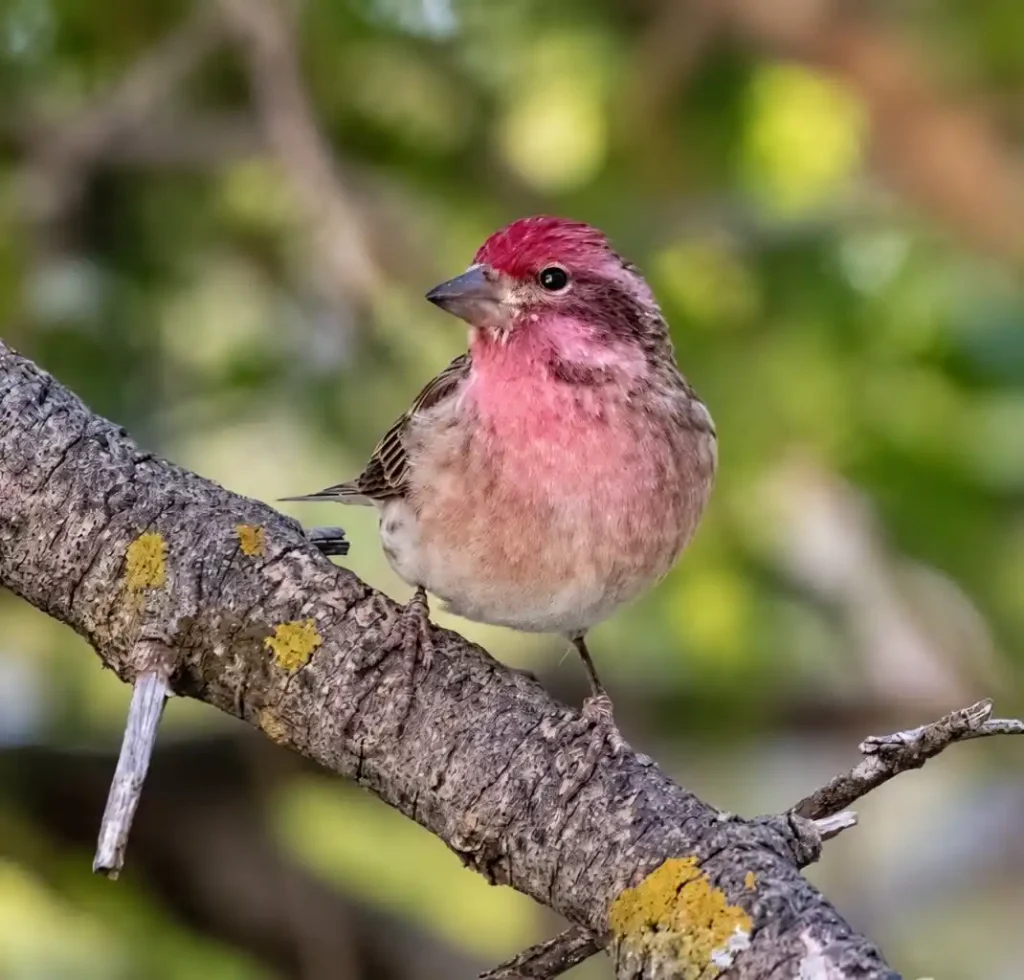
The male Cassin’s Finch has a bright red, slightly raised crown that is usually brighter than the rest of its pinkish-red head and chest. Its pale belly has little or no heavy streaking. Females and young birds are brown and streaked without red feathers.
Cassin’s Finches prefer high-elevation coniferous forests in western North America. They sometimes visit towns and feeders during winter. Compared with a House Finch, the male has a more peaked head, cleaner underparts, and a straighter bill profile.
- Scientific name: Haemorhous cassinii
- Length: About 6.3 inches
- Range: Mountains of western North America
- Best ID clue: Bright, peaked red crown
5. Red Crossbill

Male Red Crossbills range from orange-red to brick red across the head, breast, and back. Their wings are usually darker. Females are commonly olive-yellow or grayish rather than red.
The unusual bill is the quickest identification clue. Its upper and lower tips cross over each other, helping the bird pry seeds from conifer cones. Red Crossbills travel in flocks and may appear wherever cone crops are abundant. Their movements are irregular, so they may be common in an area one year and absent the next.
- Scientific name: Loxia curvirostra
- Length: 5.5–7.9 inches
- Range: Coniferous regions across North America
- Best ID clue: Crossed bill and red plumage on males
6. Pine Grosbeak

Male Pine Grosbeaks have rosy-red heads, backs, and chests with gray wings and white wing bars. Their red is generally softer than the bright color of a Northern Cardinal. Females are gray with yellowish or rusty-orange coloring on the head and rump.
These large, slow-moving finches feed on buds, seeds, and fruit. They are often surprisingly approachable. Pine Grosbeaks live mainly in northern and mountain forests, but some move south during winter when food becomes scarce.
- Scientific name: Pinicola enucleator
- Length: 7.9–10 inches
- Range: Canada, Alaska, and northern mountain regions
- Best ID clue: Large size, red head, and gray wings
7. Common Redpoll
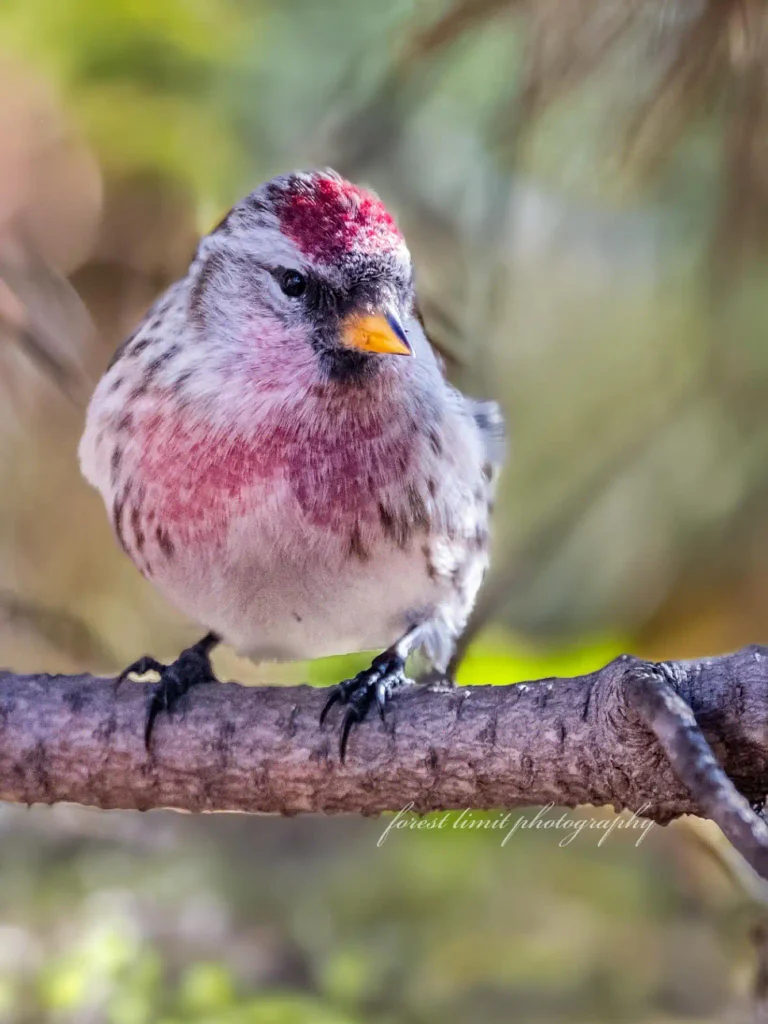
The Common Redpoll is a small, streaked finch with a tiny red patch on its forehead. Both males and females have this red crown. Adult males also show a pink wash across the chest, while females remain mostly white and brown below.
Redpolls feed on tiny seeds from birch, alder, weeds, and grasses. Large flocks sometimes arrive in the northern United States during winter. Look for their small yellow bill, black chin, streaked sides, and quick, restless feeding movements.
- Scientific name: Acanthis flammea
- Length: 4.5–5.5 inches
- Range: Arctic regions, Canada, Alaska, and northern United States in winter
- Best ID clue: Red forehead combined with a black chin
8. Summer Tanager

Adult male Summer Tanagers are red from head to tail, including the wings. Unlike male Scarlet Tanagers, they do not have black wings. Females are yellowish or mustard-colored, while young males can appear patchy red and yellow.
Summer Tanagers usually remain high in the forest canopy, where they feed on insects and fruit. They are known for catching bees and wasps. Before eating a wasp, the bird may strike it against a branch and remove the stinger.
- Scientific name: Piranga rubra
- Length: About 6.7 inches
- Range: Southern and central United States during summer
- Best ID clue: Completely red male with a pale, thick bill
9. Scarlet Tanager
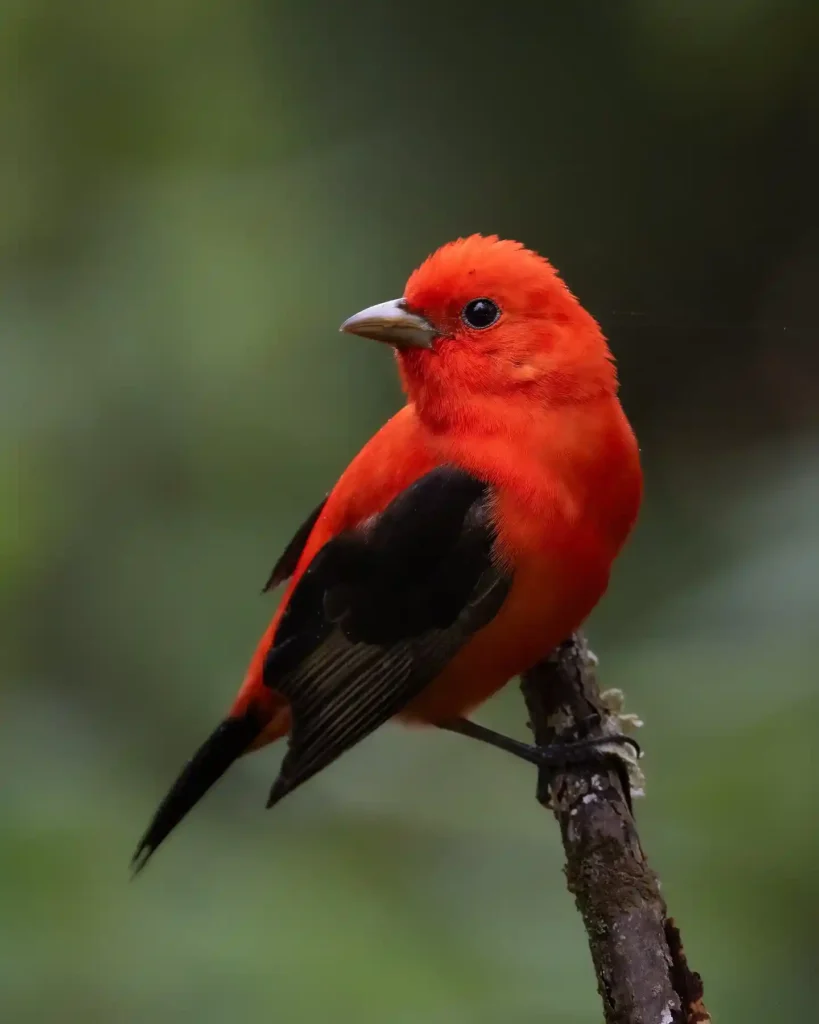
A breeding male Scarlet Tanager has a red head and body paired with jet-black wings and tail. Females are yellowish-green with darker wings. In fall, males exchange most of their red plumage for yellow-green feathers but retain their black wings.
Although brightly colored, Scarlet Tanagers can be difficult to see because they spend much of their time high in mature trees. Listen for their rough, robin-like song in eastern deciduous forests during spring and summer.
- Scientific name: Piranga olivacea
- Length: 6.3–6.7 inches
- Range: Eastern North America during breeding
- Best ID clue: Red male with solid black wings
10. Vermilion Flycatcher

The male Vermilion Flycatcher has a fiery red crown, face, chest, and belly. A dark brown mask runs through the eyes, and the wings and back are also dark. Females are gray-brown with a pale chest and peach-colored lower belly.
These small flycatchers sit on exposed fences, shrubs, and low branches while watching for flying insects. Males sometimes perform fluttering display flights above their territory. In the United States, they are most often seen in Texas, Arizona, New Mexico, and southern California.
- Scientific name: Pyrocephalus rubinus
- Length: 5.1–5.5 inches
- Range: Southwestern United States, Mexico, and farther south
- Best ID clue: Red crown and underparts with a dark eye mask
Related: 10 Owls in New York: Identification & Seasonal Guide
11. Ruby crowned Kinglet
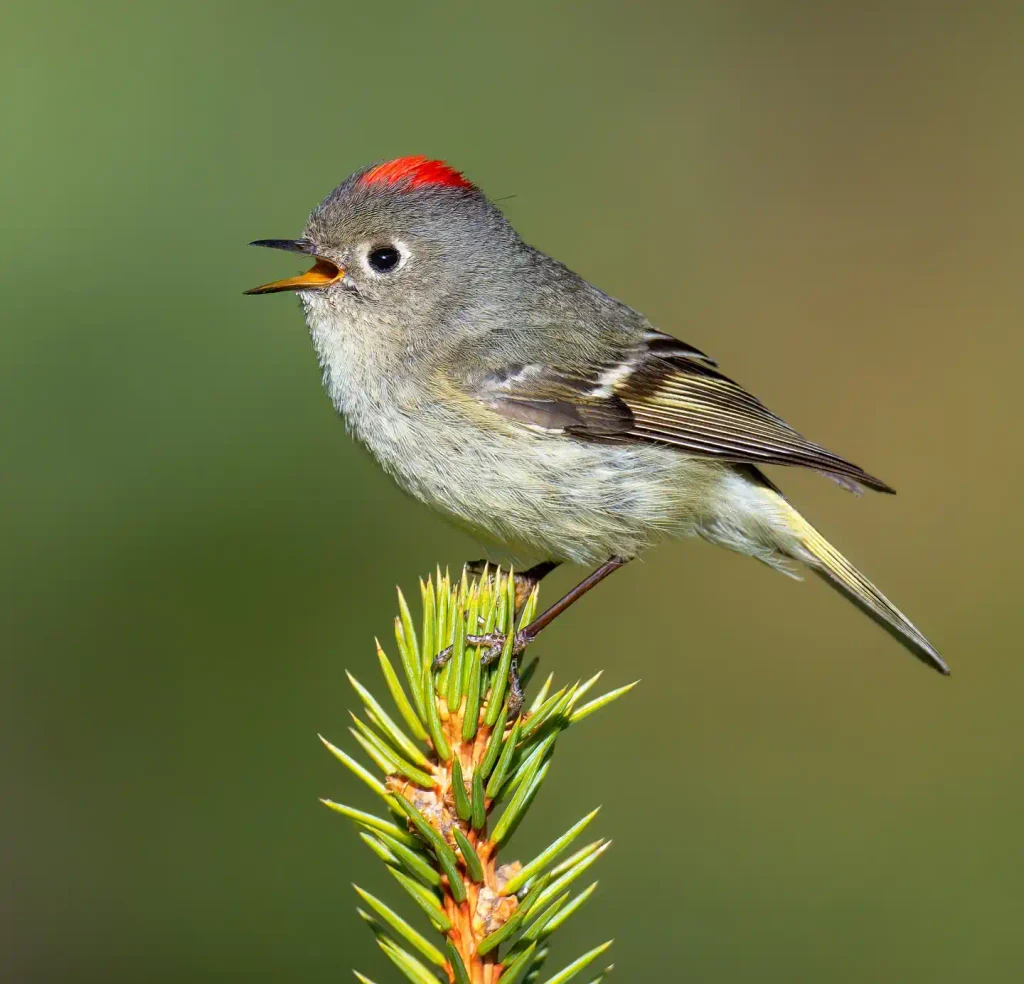
The Ruby-crowned Kinglet is a tiny olive-gray bird with a white eye ring and two pale wing bars. Adult males have a bright ruby-red crown patch, but they normally keep it hidden.
The crown appears when a male is excited, displaying, or confronting another bird. Because of this, many people watch Ruby-crowned Kinglets without ever seeing the red feathers. These active birds constantly flick their wings as they search leaves and branches for insects.
- Scientific name: Corthylio calendula
- Length: 3.5–4.3 inches
- Range: Found across much of North America during migration or winter
- Best ID clue: White eye ring and occasionally raised red crown
12. Red headed Woodpecker
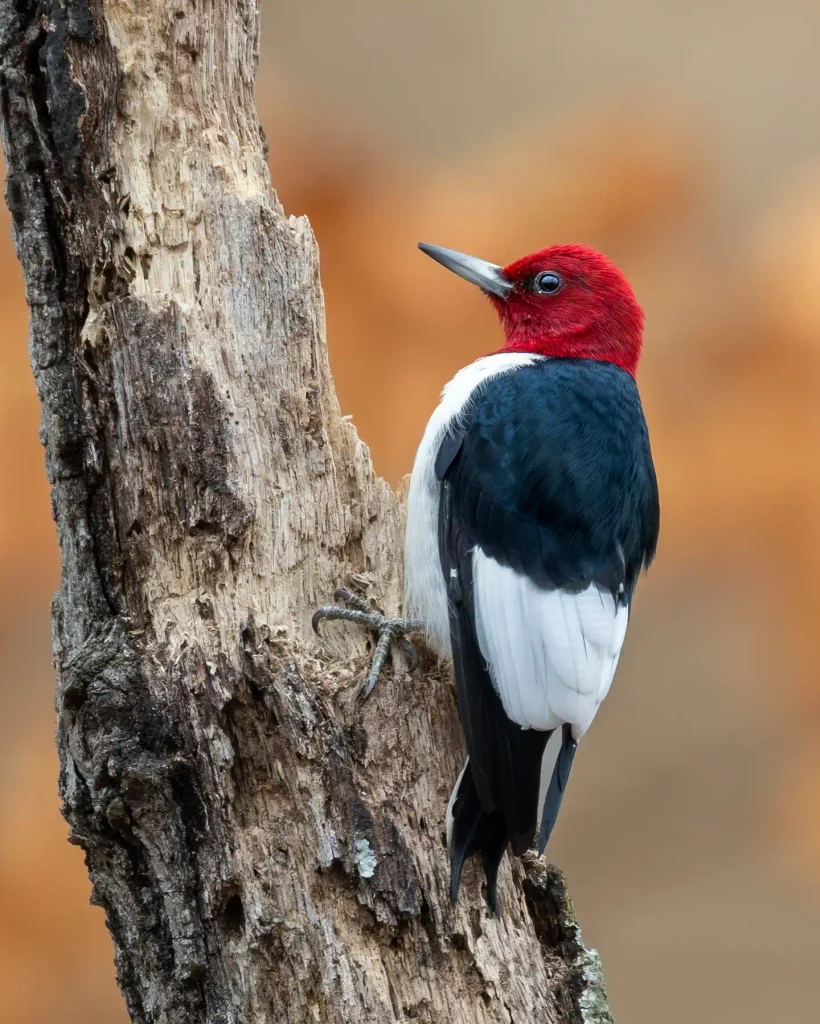
Adult Red-headed Woodpeckers have an entirely red head and neck. Their bodies are clean white with black backs, wings, and tails. Large white wing patches create a bold black and white pattern in flight.
Young birds have brownish-gray heads and gradually develop red feathers as they mature. Red-headed Woodpeckers catch insects in the air and store seeds, nuts, and insects in tree crevices. They favor open woods with standing dead trees rather than thick, unbroken forest.
- Scientific name: Melanerpes erythrocephalus
- Length: 7.5–9.1 inches
- Range: Central and eastern North America
- Best ID clue: Entire head red with a black and white body
13. Red bellied Woodpecker
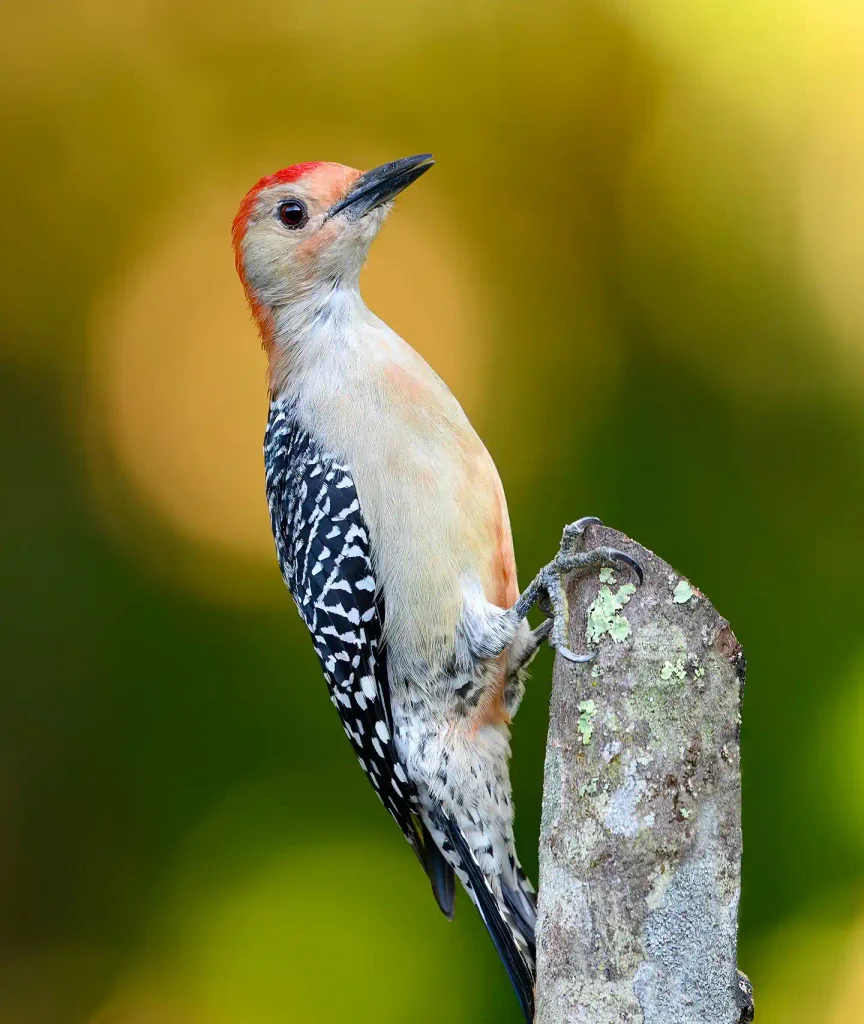
The Red-bellied Woodpecker is often noticed for its red head rather than its faint reddish belly. Adult males have red running from the forehead across the crown to the back of the neck. Females have red mainly on the nape, with a gray crown between the forehead and nape.
Its back has narrow black and white bars, while the face and underparts are pale. This common eastern woodpecker visits feeders for suet, peanuts, and sunflower seeds.
- Scientific name: Melanerpes carolinus
- Length: 9.1–10.6 inches
- Range: Eastern and central United States
- Best ID clue: Red crown with a black and white barred back
14. Pileated Woodpecker
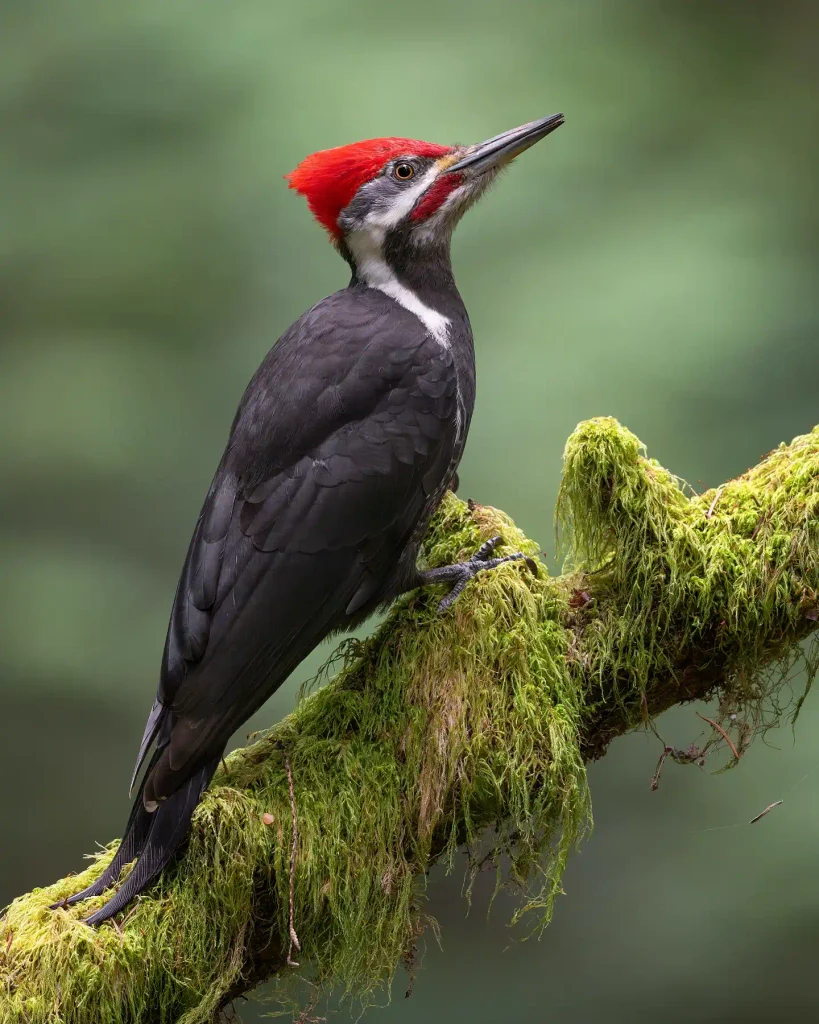
The Pileated Woodpecker is a crow-sized forest bird with a large, pointed red crest. Its body is mainly black with white stripes along the face and neck. Males also have a red cheek stripe, while females have a black cheek stripe.
Pileated Woodpeckers hammer into dead and decaying trees while searching for carpenter ants. Their feeding holes are large and rectangular rather than small and round. A loud series of ringing calls may reveal the bird before it comes into view.
- Scientific name: Dryocopus pileatus
- Length: 15.8–19.3 inches
- Range: Canada, eastern United States, and parts of the Pacific Coast
- Best ID clue: Large body and pointed red crest
15. Downy Woodpecker
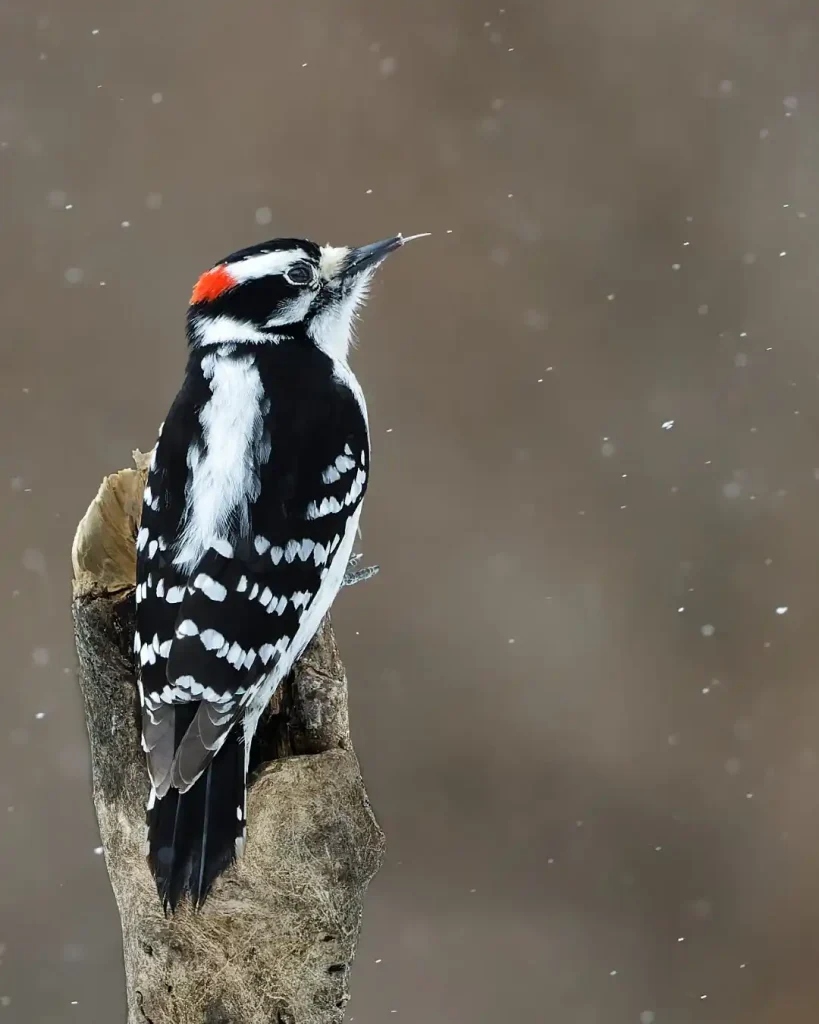
Male Downy Woodpeckers have a small red patch on the back of the head. The rest of the bird is black and white, with white spots across the wings and a broad white stripe down the center of the back. Females look similar but lack the red patch.
This is the smallest woodpecker in North America and a regular visitor to backyard suet feeders. Its bill is short and looks much smaller than its head, which helps separate it from the similar Hairy Woodpecker.
- Scientific name: Dryobates pubescens
- Length: 5.5–6.7 inches
- Range: Most of the United States and Canada
- Best ID clue: Small size and short bill
16. Hairy Woodpecker
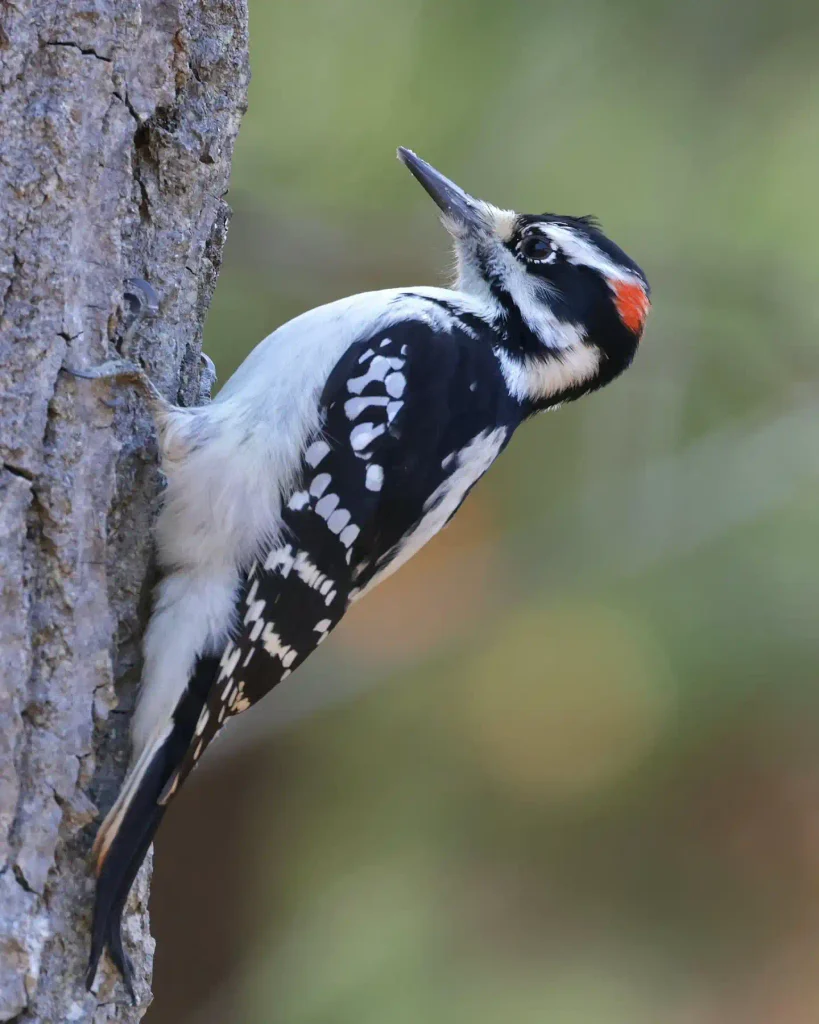
The male Hairy Woodpecker has a red patch on the back of its black and white head. Its body pattern closely resembles that of a Downy Woodpecker, but the Hairy is larger and has a much longer, stronger bill. Females lack the red patch.
Hairy Woodpeckers are often found on thick trunks and large branches in mature forests. They visit suet feeders, especially when the yard contains large trees. Their sharp call is louder and more forceful than a Downy Woodpecker’s call.
- Scientific name: Leuconotopicus villosus
- Length: 7.1–10.2 inches
- Range: Widespread across North America
- Best ID clue: Long bill nearly equal to the length of the head
17. Yellow bellied Sapsucker
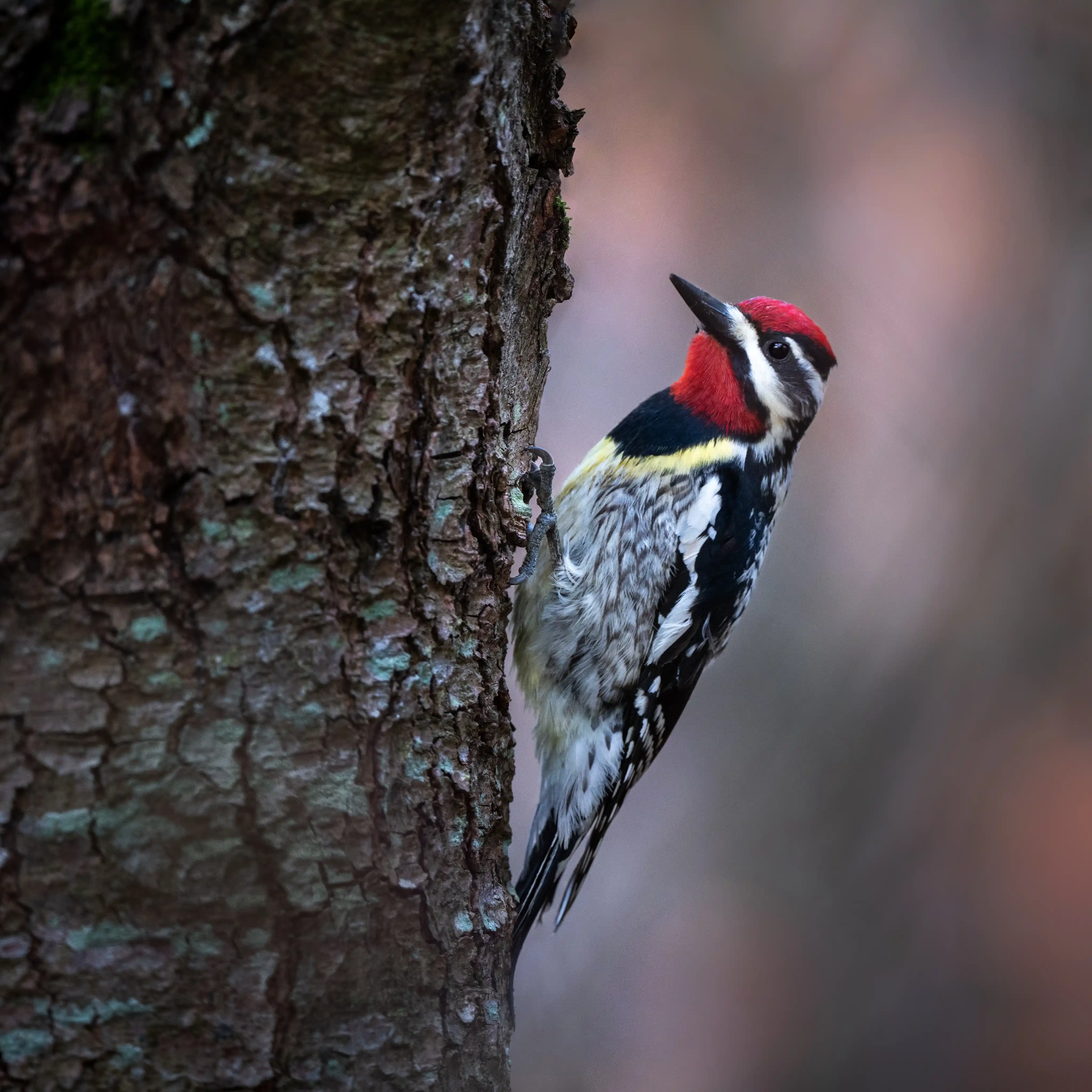
Adult Yellow-bellied Sapsuckers have red crowns, black and white faces, and a long white wing patch. Males also have red throats, while females have white throats. The pale yellow wash on the belly can be difficult to notice.
These woodpeckers drill neat rows of shallow holes in tree bark and return to drink the sap. They also eat insects attracted to the flowing sap. Many move through the eastern United States during spring and fall migration.
- Scientific name: Sphyrapicus varius
- Length: 7.1–8.7 inches
- Range: Eastern North America
- Best ID clue: Red crown with rows of sap holes nearby
18. Acorn Woodpecker
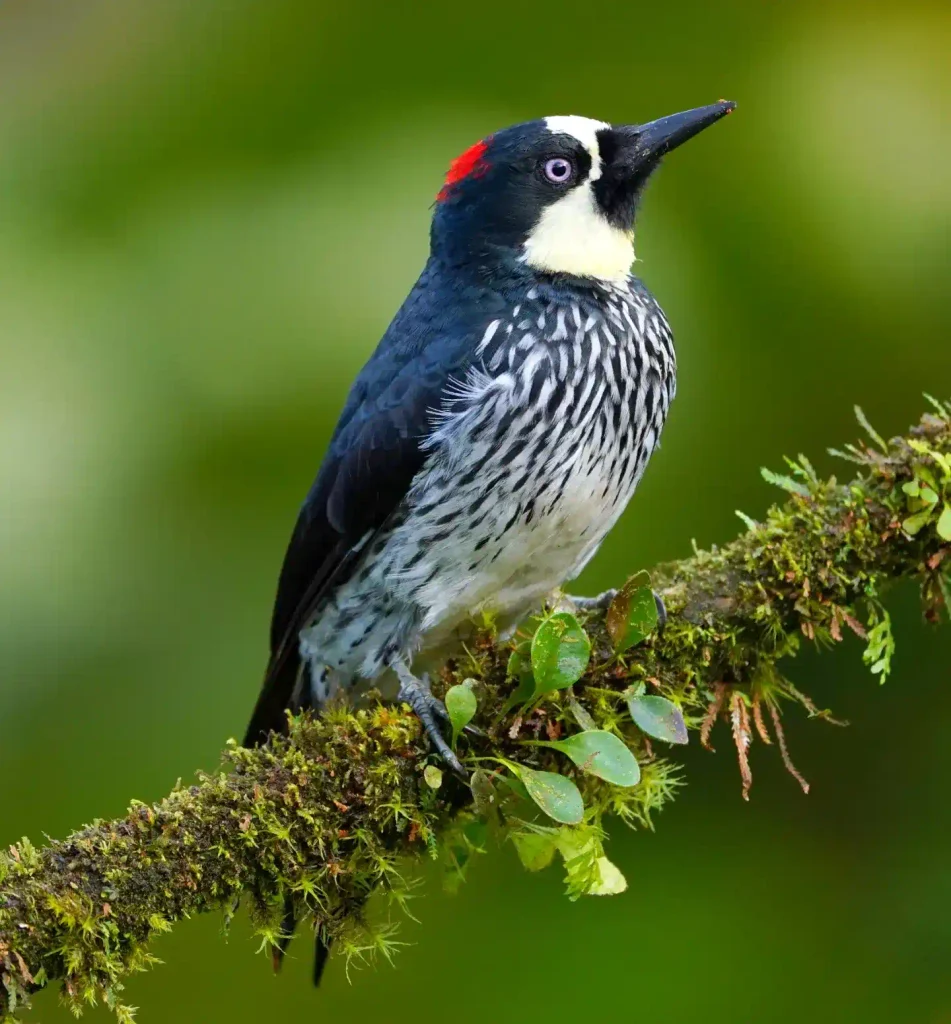
Acorn Woodpeckers have black and white faces, pale eyes, black bodies, and red crowns. Adult males have red extending from the forehead to the back of the crown. Females have a black band separating the red crown from the pale forehead.
These social woodpeckers live in family groups in western oak woodlands. They store thousands of acorns in holes drilled into trees, poles, fences, and wooden buildings. A tree covered with tightly packed acorns is known as a granary tree.
- Scientific name: Melanerpes formicivorus
- Length: 7.5–9.1 inches
- Range: Western United States, Mexico, and Central America
- Best ID clue: Red crown, pale eye, and clown-like face
How to Identify a Bird With a Red Head
First, decide how much of the head is red. A completely red head suggests a Red-headed Woodpecker, Northern Cardinal, tanager, or male finch. A small patch behind the crown is more likely to belong to a Downy or Hairy Woodpecker.
Bill shape offers another useful clue. Finches have thick seed-cracking bills, woodpeckers have straight chisel-like bills, and flycatchers have broad bills made for catching insects.
Remember to check the season and sex. Female House Finches, Purple Finches, Cassin’s Finches, and tanagers do not have the same red plumage as adult males.
FAQs
What is the most common bird with a red head?
Northern Cardinals and male House Finches are among the most common red-headed birds in residential areas. Red-bellied Woodpeckers are also widespread across the eastern United States.
What bird has a completely red head?
The adult Red-headed Woodpecker has a completely red head and neck. Male Northern Cardinals, Summer Tanagers, and Scarlet Tanagers also have heads covered in red feathers.
What small brown bird has red on its head?
A male House Finch is brown with red around the forehead, face, and chest. Common Redpolls are smaller and have a neat red cap above the bill.
What black and white bird has a red head?
Red-headed Woodpeckers have completely red heads with black and white bodies. Pileated, Downy, Hairy, Acorn, and Red-bellied Woodpeckers also combine red head markings with black and white plumage.
Do female birds have red heads?
Females of some species have red head markings. Female Common Redpolls and Red-headed Woodpeckers show red, while female cardinals have a reddish crest. Female House Finches, Purple Finches, and Cassin’s Finches lack red plumage.
Why do male birds have brighter red heads?
Bright feathers can help males signal their condition and attract mates. In some species, food pigments affect the intensity of red or orange plumage. Color may also help birds recognize members of their own species.
