
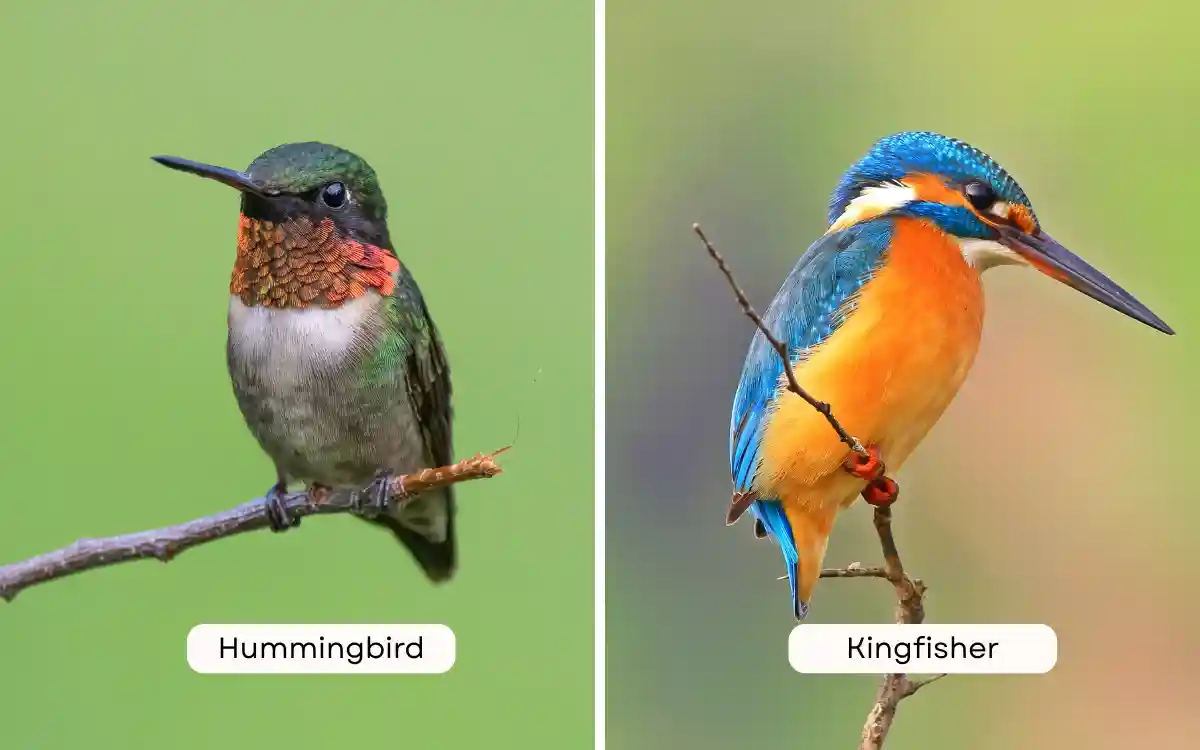
A hummingbird and a kingfisher are both eye-catching birds with specialized bills, fast movement, and strong hunting or feeding skills. But they are not closely similar in lifestyle.
A hummingbird is tiny, nectar-loving, and built for hovering around flowers. Cornell describes Ruby-throated Hummingbirds as very small birds with long, thin bills that hover with great control while feeding at flowers.
A kingfisher, especially the Belted Kingfisher in North America, is a stocky water hunter with a large head, shaggy crest, and thick pointed bill. Cornell describes Belted Kingfishers as large-headed birds with a shaggy crest and a straight, thick, pointed bill.
So the simple answer is this: hummingbirds are tiny nectar-feeding hoverers, while kingfishers are fish-catching water birds that dive from perches.
Hummingbird Overview
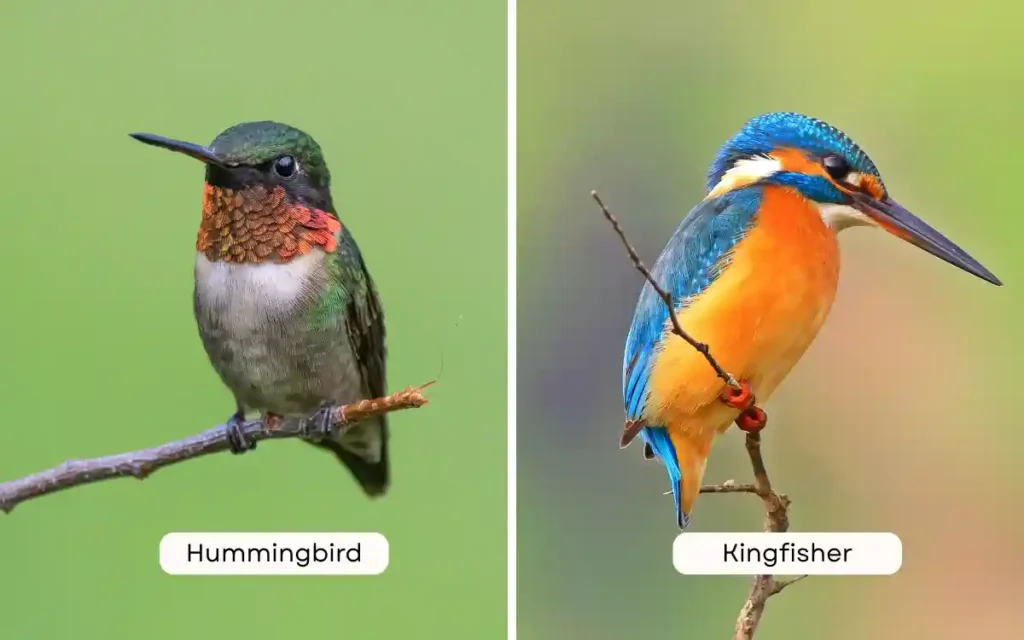
Hummingbirds are among the smallest birds in the world. In North America, the Ruby-throated Hummingbird is the most familiar species in the eastern region. Audubon notes that the Ruby-throated Hummingbird is the only breeding hummingbird in eastern North America and beats its wings more than 50 times per second while hovering at flowers.
They are built for speed and control. A hummingbird can hover in place, move backward, dart sideways, and disappear quickly into shrubs or trees. This makes them very different from most birds.
Main hummingbird traits
Hummingbirds usually have:
| Trait | What It Means |
| Tiny body | They are much smaller than most backyard birds |
| Long thin bill | Helps reach nectar inside flowers |
| Fast wingbeats | Creates the humming sound |
| Hovering flight | Lets them feed without landing |
| High energy needs | They feed often throughout the day |
| Iridescent feathers | Males often show bright throat colors |
Hummingbirds do not eat only nectar. They also catch small insects and spiders for protein, but nectar is the food people notice most because they visit flowers and sugar-water feeders.
Learn more about:-
Kingfisher Overview
Kingfishers are very different birds. The Belted Kingfisher is a common North American example. It is often seen near rivers, streams, ponds, lakes, and shorelines.
Cornell describes the Belted Kingfisher as a top-heavy bird with energetic flight and a loud rattling call. It nests in burrows along earthen banks and feeds mostly on aquatic prey by diving after fish and crayfish.
A kingfisher’s body is built around fishing. It has a large head, strong neck, sharp bill, and the patience to watch water from a perch before diving.
Main kingfisher traits
Kingfishers usually have:
| Trait | What It Means |
| Large head | Helps support a strong fishing bill |
| Thick pointed bill | Used to catch fish and aquatic prey |
| Short legs | Not made for walking much |
| Shaggy crest | Common in Belted Kingfishers |
| Water habitat | Usually found near fish-rich water |
| Diving behavior | Plunges headfirst into water |
Audubon notes that Belted Kingfishers watch for prey from branches, wires, rocks, or other perches above water, and may hover before diving headfirst to catch prey.
Hummingbird vs Kingfisher: Size
Size is the fastest difference.
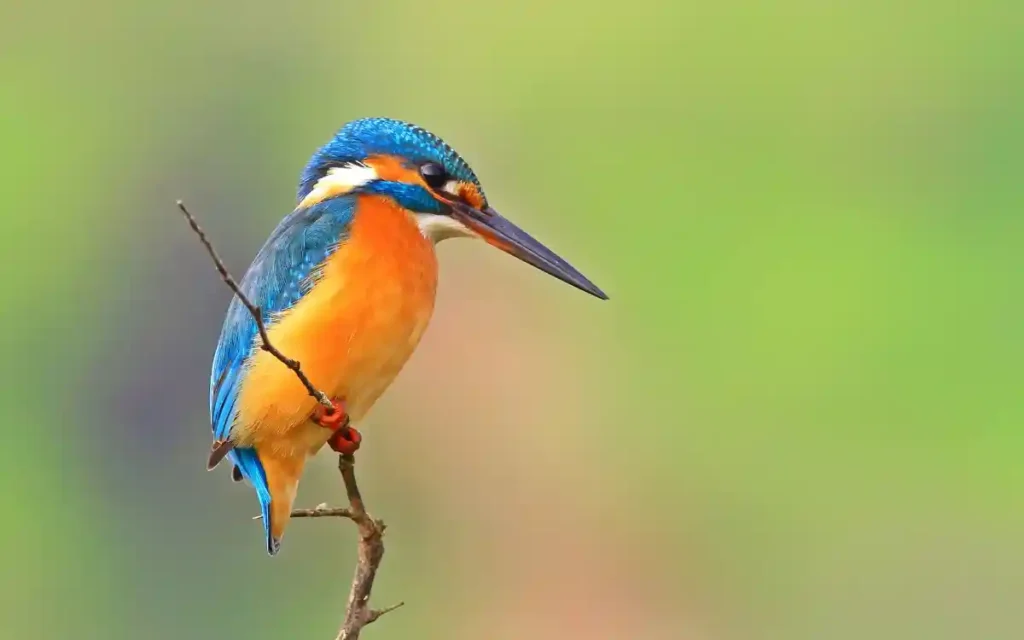
A hummingbird is tiny. A Ruby-throated Hummingbird is only a few inches long and can look insect-like when moving quickly. A kingfisher is much larger, with a thick body, large head, and heavy bill.
| Size Feature | Hummingbird | Kingfisher |
| General size | Tiny | Medium-sized |
| Body look | Light and delicate | Stocky and top-heavy |
| Head | Small | Large |
| Bill | Thin and needle-like | Thick and dagger-like |
| Perch look | Small, upright, delicate | Big-headed, rugged, alert |
Winner for smallest bird: Hummingbird
Winner for stronger body: Kingfisher
Hummingbird vs Kingfisher: Bill Shape
Both birds have long bills, but the purpose is completely different.
A hummingbird’s bill is long and thin. It helps the bird reach nectar inside flowers. The tongue does the real nectar work, but the bill gives access to deep blooms.
A kingfisher’s bill is thick, straight, and pointed. It works like a spear or forceps for catching slippery prey. Belted Kingfishers use this bill to grab fish, crayfish, and other aquatic animals.
| Bill Feature | Hummingbird | Kingfisher |
| Shape | Thin and needle-like | Thick and pointed |
| Main job | Reaching nectar | Catching fish |
| Strength | Delicate | Powerful |
| Best comparison | Tiny straw-like tool | Dagger-like fishing tool |
Simple ID tip:
If the bill looks like a thin needle, think hummingbird. If it looks like a thick dagger, think kingfisher.
Hummingbird vs Kingfisher: Food
Their diets are almost opposite.
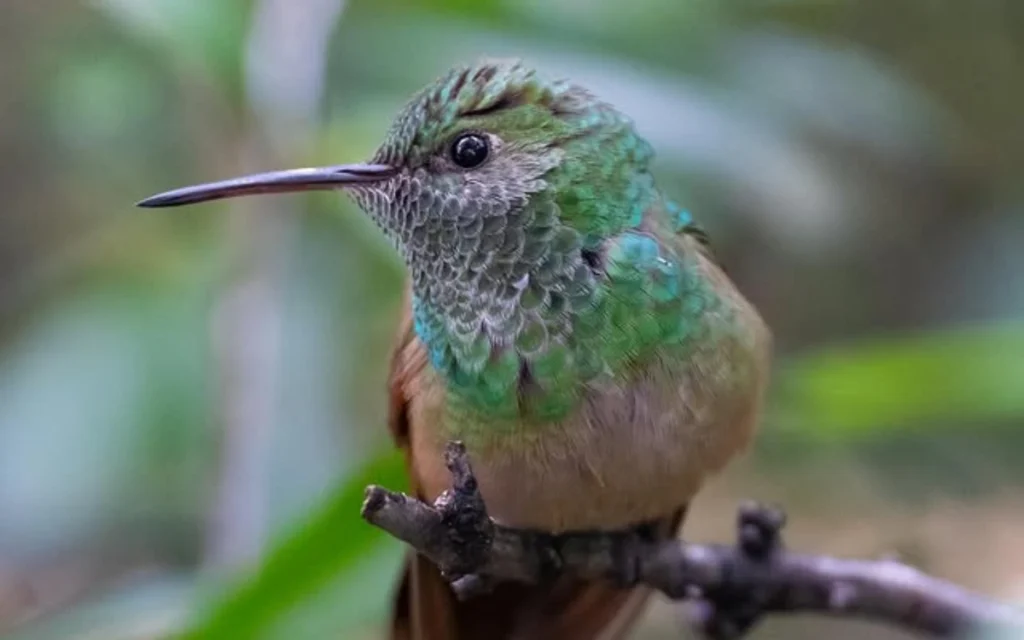
Hummingbirds feed mostly on nectar and small arthropods. They visit flowers, feeders, and sometimes catch tiny insects in the air or from leaves.
Kingfishers are water hunters. Belted Kingfishers feed mainly on fish and crayfish, but may also take other small aquatic animals. Cornell says Belted Kingfishers feed almost entirely on aquatic prey.
| Food Type | Hummingbird | Kingfisher |
| Nectar | Yes | No |
| Tiny insects | Yes | Sometimes not main food |
| Fish | No | Yes |
| Crayfish | No | Yes |
| Feeder food | Sugar-water feeders | Not typical |
| Hunting style | Flower feeding and tiny insect catching | Perch, watch, dive |
Hummingbird vs Kingfisher: Flight
This is one of the most interesting differences.
Hummingbirds are famous for hovering. They can hold their position in front of a flower, fly backward, and change direction quickly. BBC Earth notes that hummingbirds can fly forward and backward and hover in mid-air like tiny helicopters.
Kingfishers also may hover, but only briefly. Their main style is different: they fly strongly over water, perch near water, and dive when they spot prey. Their flight often looks direct, fast, and purposeful.
| Flight Feature | Hummingbird | Kingfisher |
| Hovering | Main skill | Sometimes before diving |
| Backward flight | Yes | No normal backward flight |
| Flight sound | Humming wing sound | Wingbeats plus loud call |
| Movement | Tiny darts and stops | Direct flight over water |
| Main use | Feeding from flowers | Hunting fish |
Best flight clue:
A bird hovering at flowers is probably a hummingbird. A bird rattling along a river and diving into water is probably a kingfisher.
Hummingbird vs Kingfisher: Habitat
Hummingbirds and kingfishers usually live in different places.
Hummingbirds are common around flower gardens, forest edges, meadows, yards, and feeders. They go where nectar and small insects are available.
Kingfishers stay close to water. You may see them along rivers, streams, ponds, lakes, estuaries, marsh edges, and shorelines. Chesapeake Bay Program notes that Belted Kingfishers live near streams, rivers, ponds, lakes, and estuaries where trees offer perches for watching fish.
| Habitat | Hummingbird | Kingfisher |
| Flower garden | Common | Unlikely |
| Nectar feeder | Common | No |
| Riverbank | Possible nearby, but not typical | Very common |
| Pond or lake | May pass through | Common |
| Forest edge | Common | Sometimes if water is nearby |
| Shoreline | Some may migrate near coast | Common for many kingfishers |
Hummingbird vs Kingfisher: Nesting
Their nests are completely different.
A hummingbird builds a tiny cup nest, often on a small branch. The nest may use plant down, lichens, and spider silk. It is small, stretchy, and well-hidden.
A Belted Kingfisher digs a tunnel into an earthen bank. This is one of the most surprising things about kingfishers. Cornell says Belted Kingfishers nest in burrows along earthen banks.
| Nesting Feature | Hummingbird | Kingfisher |
| Nest type | Tiny cup nest | Burrow tunnel |
| Nest location | Tree or shrub branch | Earthen bank near water |
| Main material | Plant fibers, spider silk, lichens | Dug soil tunnel |
| Nest visibility | Usually hidden | Entrance hole may be visible |
Hummingbird vs Kingfisher: Sound
Hummingbirds are not silent, but their most famous sound is the wing hum. They may also make small chips or squeaks.
Kingfishers are loud. The Belted Kingfisher is known for its harsh rattling call. Cornell describes Belted Kingfisher calls as strident mechanical rattles.
| Sound | Hummingbird | Kingfisher |
| Wing sound | Humming buzz | Not the main clue |
| Voice | Small chips/squeaks | Loud rattle |
| How you notice it | At flowers or feeders | Along water before you see it |
Are Hummingbirds and Kingfishers Related?
They are both birds, but they are not close in the way a duck and goose are close.
Hummingbirds belong to the hummingbird family, built around nectar feeding and specialized flight. Kingfishers belong to the kingfisher family, built around hunting fish and other prey, often near water.
They evolved very different bodies for very different jobs.
Which Bird Is Faster?
This depends on what you mean by faster.
Hummingbirds are better at tight, quick, controlled movement. They can hover and change direction in very small spaces.
Kingfishers are stronger straight-line fliers and better plunge divers. They are not as agile around flowers, but they are excellent at flying over water and diving after prey.
| Skill | Better Bird |
| Hovering at flowers | Hummingbird |
| Backward flight | Hummingbird |
| Diving into water | Kingfisher |
| Catching fish | Kingfisher |
| Quick garden movement | Hummingbird |
| Strong water patrol flight | Kingfisher |
Which Bird Is Easier to Attract?
For most backyard bird lovers, hummingbirds are easier to attract.
You can attract hummingbirds with nectar-rich flowers and a clean sugar-water feeder. Avoid red dye and keep feeders clean.
Kingfishers are harder to attract because they need the right water habitat. A yard pond may not be enough unless it has fish, clear water, safe perches, and suitable nearby banks.
| Attraction Method | Hummingbird | Kingfisher |
| Flower garden | Excellent | Not useful |
| Nectar feeder | Excellent | No |
| Fish pond | Not needed | Helpful if natural and safe |
| Perches near water | Not main need | Important |
| Earthen bank | Not needed | Useful for nesting |
| Easy backyard visitor | Yes in right range | Only if habitat fits |
Hummingbird vs Kingfisher: Simple ID Guide
Use these quick questions:
| Question | If Yes, It Is Likely |
| Is it hovering at flowers? | Hummingbird |
| Is it visiting a nectar feeder? | Hummingbird |
| Is it tiny and insect-like? | Hummingbird |
| Is it perched above water? | Kingfisher |
| Does it have a shaggy crest and huge bill? | Kingfisher |
| Did it dive headfirst into water? | Kingfisher |
| Did it make a loud rattling call? | Kingfisher |
FAQs
Are hummingbirds and kingfishers the same type of bird?
No. Hummingbirds are tiny nectar-feeding birds, while kingfishers are larger water-hunting birds. They have different diets, habitats, body shapes, and nesting styles.
Can kingfishers hover like hummingbirds?
Kingfishers can hover briefly before diving, but they do not hover with the same control or frequency as hummingbirds. Hummingbirds are built for sustained hovering at flowers.
Do hummingbirds eat fish?
No. Hummingbirds do not eat fish. They feed mainly on nectar and small insects or spiders.
Do kingfishers drink nectar?
No. Kingfishers do not visit flowers for nectar. They mainly hunt fish and other aquatic prey near water.
Which is smaller, a hummingbird or a kingfisher?
A hummingbird is much smaller. A kingfisher is a medium-sized bird with a large head, thick bill, and stocky body.
Why do both birds have long bills?
They have long bills for different reasons. A hummingbird uses its thin bill to reach nectar in flowers. A kingfisher uses its thick pointed bill to catch fish and aquatic prey.
