
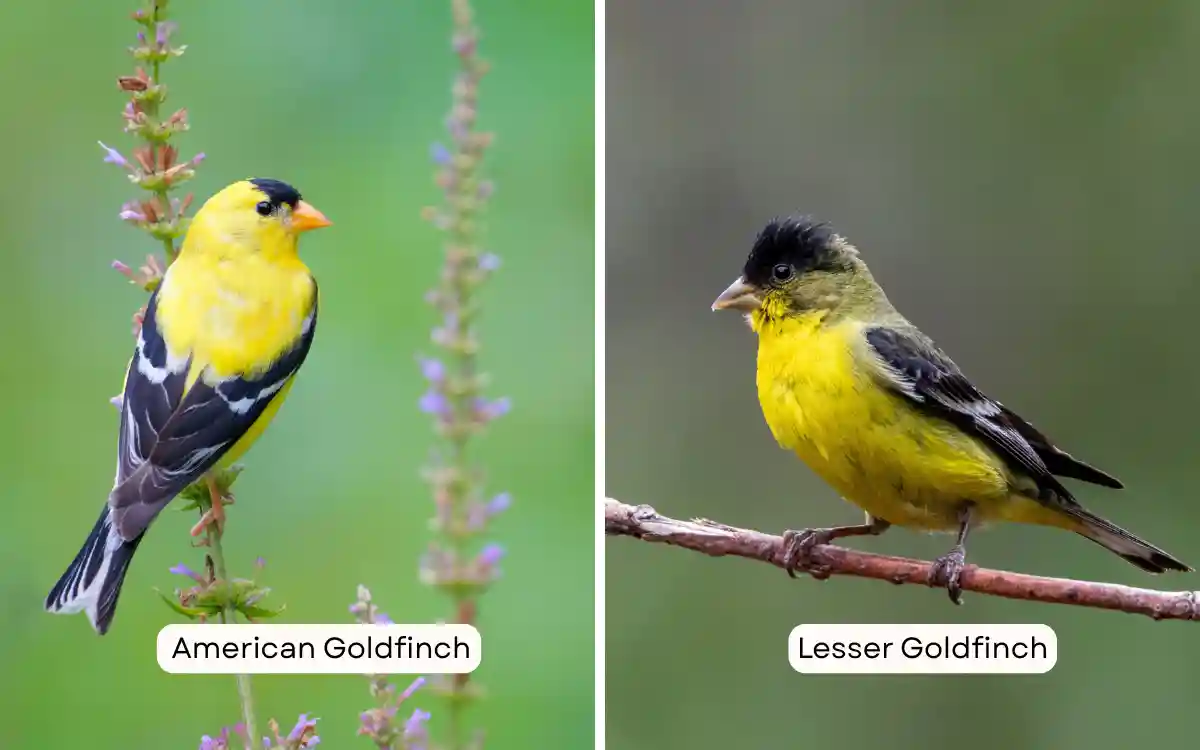
American Goldfinches and Lesser Goldfinches can look very similar at first. Both are small yellow finches, both eat seeds, both may visit feeders, and both can show black wings with pale markings.
The fastest way to tell them apart is this: American Goldfinches are usually a little larger, with brighter yellow breeding males, a black forehead, and bold wing bars. Lesser Goldfinches are smaller, often have a full black cap, and males may have either a black back or a green back depending on region.
Range also helps. American Goldfinches are widespread across much of North America, while Lesser Goldfinches are mainly birds of the western and southwestern United States, Mexico, and nearby regions. Cornell describes American Goldfinches as small finches with short conical bills and black wings in spring males, while Lesser Goldfinches are tiny stub-billed birds with bright yellow underparts, black caps, and white patches in the wings.
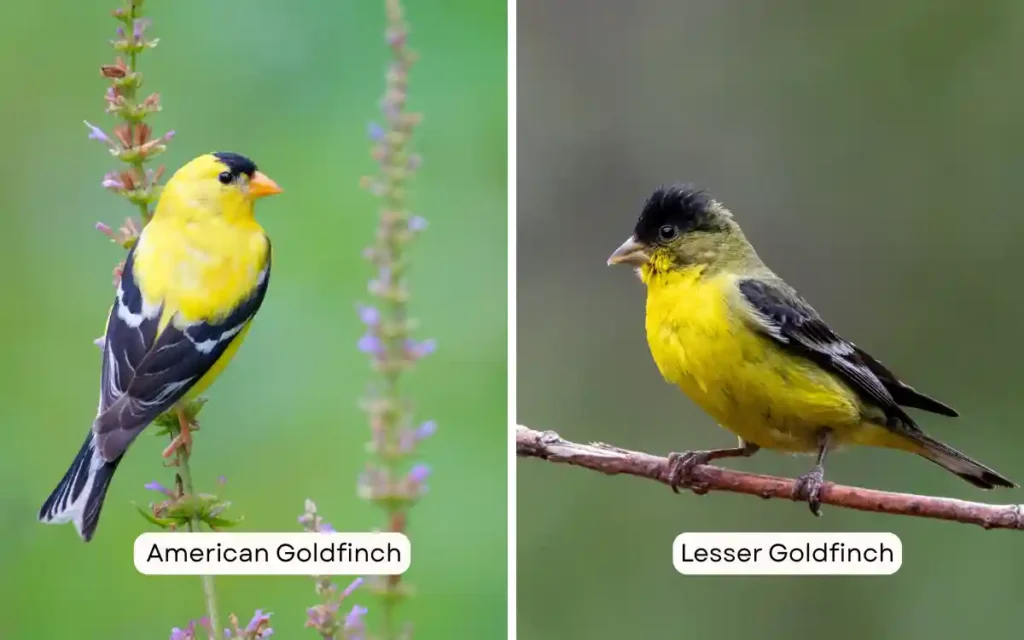
Quick Difference Table
| Feature | American Goldfinch | Lesser Goldfinch |
| Size | Small | Even smaller |
| Male head | Black forehead only | Usually black cap |
| Male back | Bright yellow or olive, not fully black | Black-backed or green-backed |
| Wings | Black with clear white wing bars | Black wings with white patches |
| Bill | Short, conical, often pale/orange in breeding season | Smaller, often grayish or darker |
| Female | Olive-yellow or dull yellow | Olive above, dull yellow below |
| Range | Widespread across North America | Mostly western and southwestern areas |
| Feeder food | Nyjer, sunflower seeds | Nyjer, sunflower seeds |
| Best clue | Bright yellow male with black forehead | Tiny yellow finch with black cap |
American Goldfinch
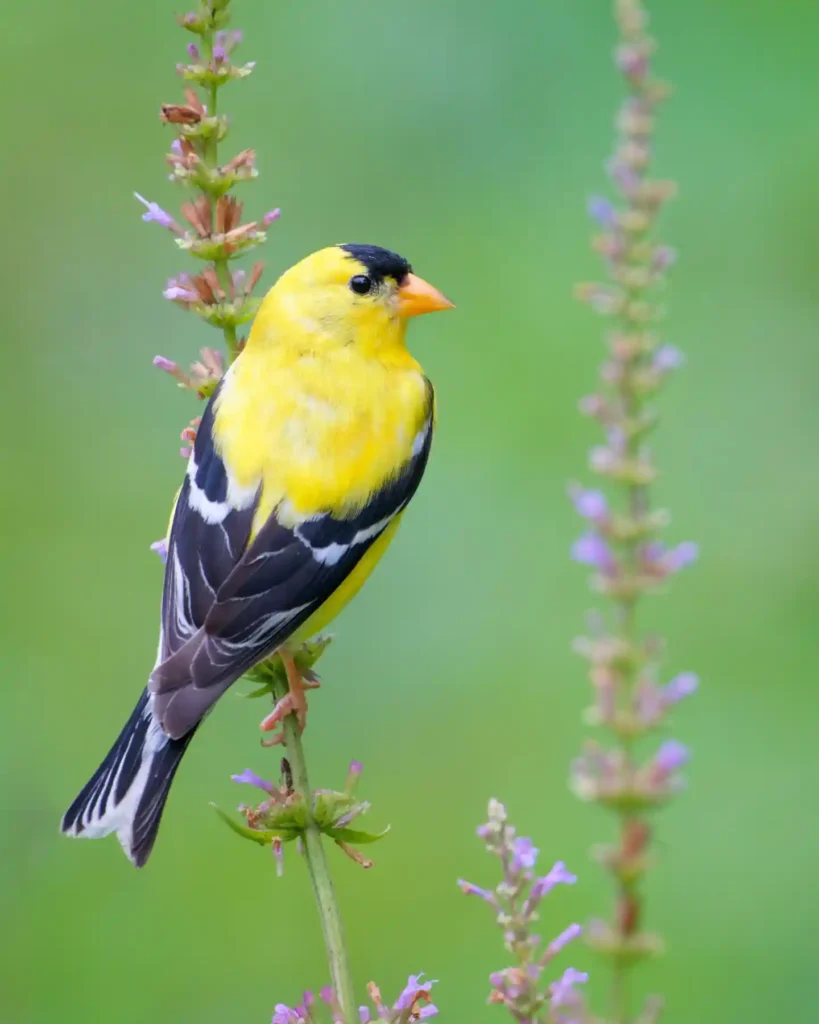
Quick ID: Bright yellow male with black wings, white wing bars, and a black forehead.
What It Looks Like:
Male American Goldfinches are bright yellow in spring and summer, with black wings, white wing markings, and a small black forehead. Females are duller, often olive-yellow or brownish-yellow. In winter, both males and females become much less bright, which can confuse readers who expect goldfinches to stay yellow all year. Audubon notes that winter American Goldfinches can vary from yellowish-brown to gray, while still showing bold wing bars on black wings.
Where You’ll Find It:
Look for American Goldfinches in backyards, gardens, weedy fields, roadsides, meadows, open woods, and areas with seed-bearing plants. They are common feeder birds, especially where nyjer or sunflower seeds are offered.
Behavior Clues:
American Goldfinches often travel in small flocks and fly with a bouncy, up-and-down pattern. They cling to seed heads, perch on feeder ports, and often feed quietly in groups.
How to Tell It Apart:
Compared with Lesser Goldfinch, American Goldfinch is usually a bit larger and brighter in breeding plumage. The male has a black forehead, not a full black cap that covers more of the head.
Best Time to See:
Spring and summer are best for bright yellow males. Winter birds are duller but still common at feeders in many areas.
Backyard Tip:
Offer nyjer seed and black oil sunflower seed. Native sunflowers, coneflowers, and thistles can also bring them into a bird-friendly yard.
Lesser Goldfinch
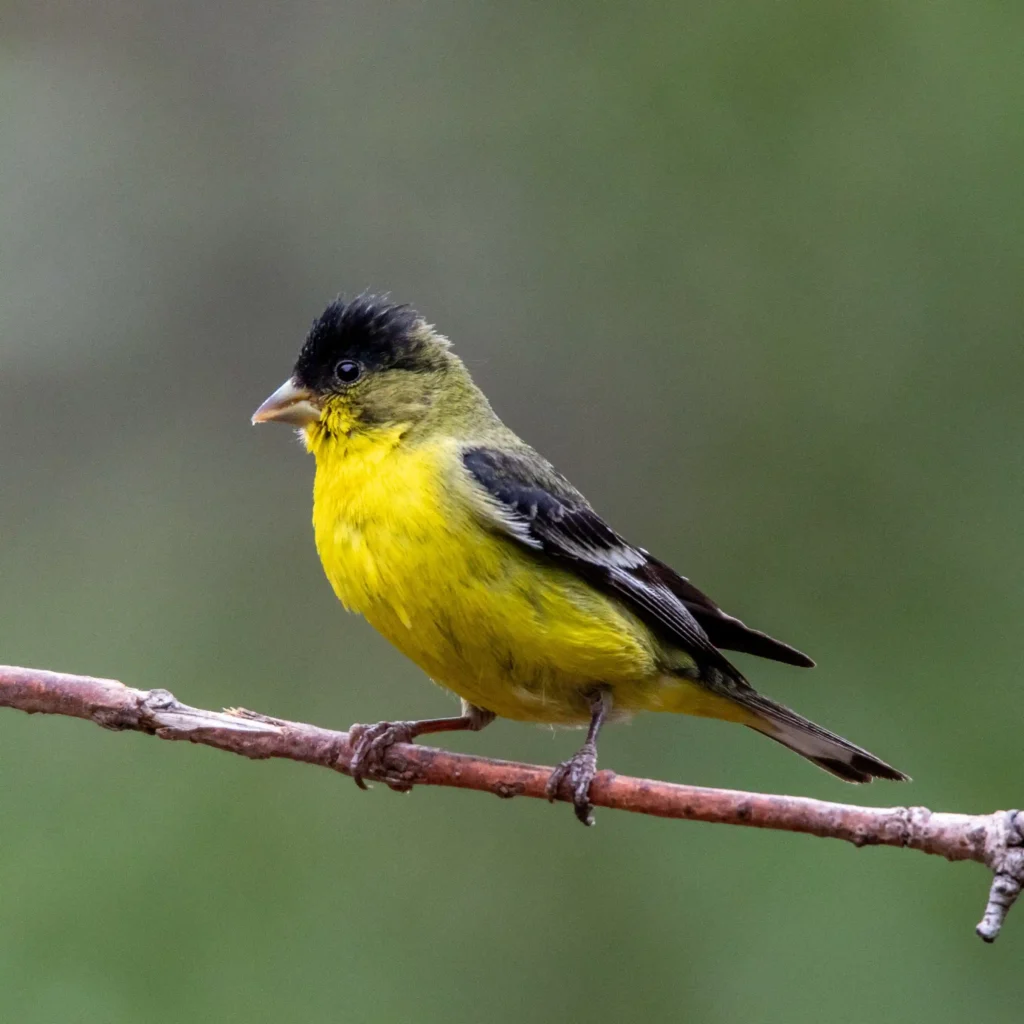
Quick ID: Tiny yellow finch with a black cap, white wing patches, and either a black or greenish back.
What It Looks Like:
Male Lesser Goldfinches are bright yellow below with a glossy black cap. Their backs can be black or dull green, depending on region. Females and young birds are plainer, with olive backs, dull yellow underparts, and dark wings with pale wing bars. Audubon describes Lesser Goldfinch as a very small finch with white patches in the wings and tail, and notes that many males from Colorado to Texas have black backs, while many farther west have green backs.
Where You’ll Find It:
Lesser Goldfinches are most common in the western and southwestern United States. Look for them in gardens, parks, brushy edges, open woodland, desert washes, farms, and weedy areas.
Behavior Clues:
They move in active flocks and often feed on small seeds. Like American Goldfinches, they may visit nyjer feeders and sunflower feeders, but they often feel more tied to western dry habitats and brushy edges.
How to Tell It Apart:
The smaller size, black cap, and darker or greener back are the best clues. If the bird has a full black cap instead of just a black forehead, think Lesser Goldfinch.
Best Time to See:
In many western areas, Lesser Goldfinches can be seen year-round.
Backyard Tip:
Use nyjer seed feeders, keep seed-bearing native plants, and leave some natural edges instead of making the whole yard bare.
Fast ID: Which Goldfinch Did You See?
| What You Saw | More Likely Bird |
| Bright yellow male with black forehead only | American Goldfinch |
| Tiny yellow bird with full black cap | Lesser Goldfinch |
| Yellow bird with black back in Texas/Colorado region | Lesser Goldfinch |
| Yellow bird with greenish back in California or West Coast | Lesser Goldfinch |
| Dull winter finch with bold wing bars | American Goldfinch |
| Finch at nyjer feeder in the East | American Goldfinch |
| Finch at nyjer feeder in the Southwest | Could be either, check head and back |
| Female with olive back and dull yellow underparts | Could be Lesser; compare size and range |
| Larger, brighter yellow breeding male | American Goldfinch |
| Smaller, darker, more compact finch | Lesser Goldfinch |
Biggest Difference: Head Pattern
The head is often the easiest clue.
American Goldfinch male: black forehead only.
Lesser Goldfinch male: black cap, often covering more of the head.
This is especially useful when the bird is perched at a feeder and you only get a quick look.
Back Color Difference
American Goldfinches do not usually show the same strong black-backed or green-backed look as male Lesser Goldfinches.
Lesser Goldfinch males can have:
- Black back: more common from parts of Colorado and Texas southward
- Green back: more common farther west, including many West Coast areas
This back color variation is one reason Lesser Goldfinches can confuse beginners.
Female American Goldfinch vs Female Lesser Goldfinch
Females are harder than males because both can look olive-yellow and dull.
| Feature | Female American Goldfinch | Female Lesser Goldfinch |
| Size | Slightly larger | Slightly smaller |
| Back | Olive, tan, or dull brownish | Olive or greenish |
| Underparts | Dull yellow or buffy | Dull yellow |
| Wings | Dark with pale wing bars | Dark with pale wing bars |
| Best clue | Larger, often paler bill | Smaller, darker-looking bill |
| Range help | Common across much of North America | Mostly western/southwestern |
My opinion: for females, range + size + bill shape matters more than color. A single quick photo can be tricky.
Do They Visit the Same Feeders?
Yes, both can visit feeders.
| Food | American Goldfinch | Lesser Goldfinch |
| Nyjer seed | Yes | Yes |
| Black oil sunflower seed | Yes | Yes |
| Hulled sunflower chips | Yes | Yes |
| Native seed heads | Yes | Yes |
| Suet | Rare | Rare |
| Fruit | Not a main food | Not a main food |
Both are seed-eating finches, so feeder behavior alone is not enough for identification.
Range: One of the Best Clues
Range can quickly narrow it down.
American Goldfinch: widespread across much of the United States and southern Canada.
Lesser Goldfinch: mostly western and southwestern, with strong presence in places like California, Arizona, New Mexico, Texas, and nearby areas.
So, if you see a yellow goldfinch in New York, Pennsylvania, Ohio, or much of the eastern United States, it is far more likely to be an American Goldfinch. If you are in California, Arizona, New Mexico, or Texas, check carefully because Lesser Goldfinch becomes much more likely.
Common Mistakes
Mistake 1: Thinking every small yellow finch is American Goldfinch
In the West and Southwest, Lesser Goldfinches are common. Always check for a full black cap and dark or greenish back.
Mistake 2: Ignoring winter plumage
American Goldfinches turn much duller in winter. A brownish-yellow bird with black wings and wing bars may still be an American Goldfinch.
Mistake 3: Using feeder behavior alone
Both species may eat nyjer and sunflower seeds. Feeder choice does not confirm the bird.
Mistake 4: Forgetting regional variation in Lesser Goldfinch
Some male Lesser Goldfinches have black backs, while others have green backs. This does not mean they are different species.
Simple Memory Trick
Use this:
American Goldfinch = black forehead, brighter yellow, wider range.
Lesser Goldfinch = smaller bird, black cap, western range.
That one line will solve most beginner confusion.
FAQs
Is a Lesser Goldfinch the same as an American Goldfinch?
No. They are different goldfinch species. They look similar, but Lesser Goldfinches are usually smaller and often have a full black cap.
Which is smaller, American Goldfinch or Lesser Goldfinch?
The Lesser Goldfinch is generally smaller. Audubon lists Lesser Goldfinch at about 3.5–4.3 inches, while American Goldfinch is about 4–5 inches.
What is the easiest way to tell them apart?
Look at the head. Male American Goldfinches have a black forehead. Male Lesser Goldfinches usually have a fuller black cap.
Do American Goldfinches and Lesser Goldfinches eat the same food?
Yes. Both eat seeds and may visit nyjer and sunflower feeders.
Can Lesser Goldfinches have green backs?
Yes. Many Lesser Goldfinches in western areas have greenish backs, while others have black backs.
Which goldfinch is more common in the eastern United States?
American Goldfinch is much more likely in the eastern United States. Lesser Goldfinch is mainly western and southwestern.
