
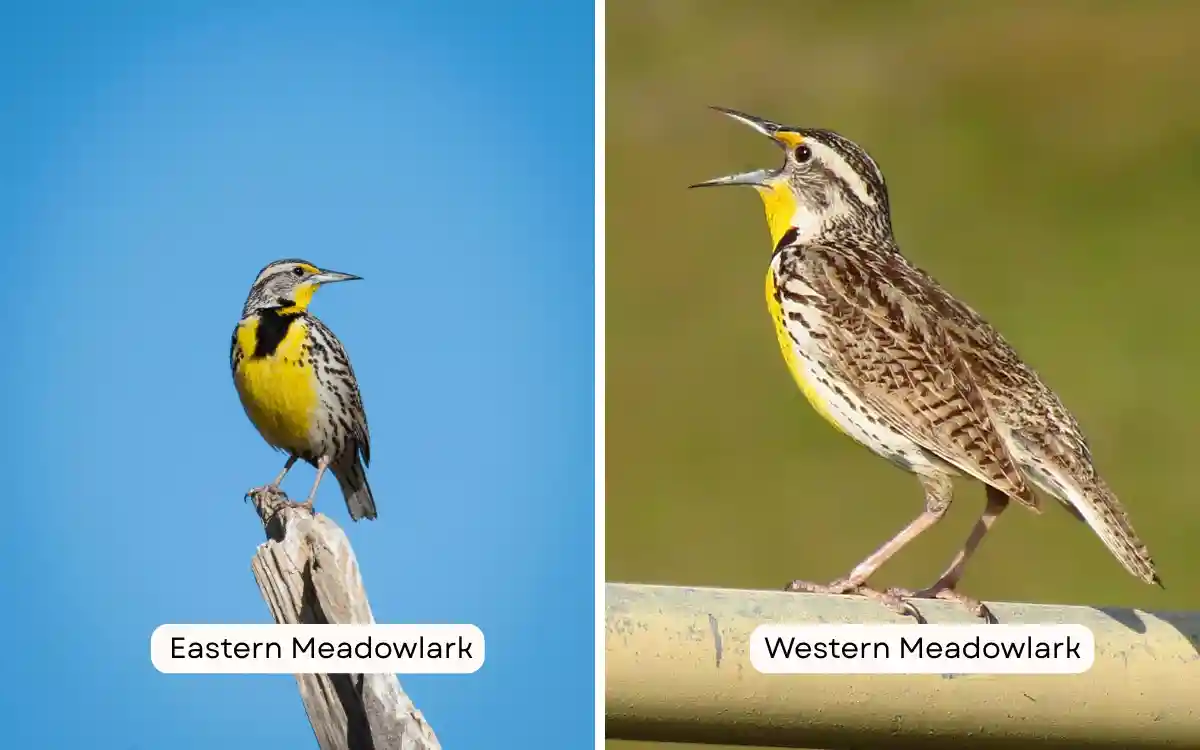
Eastern Meadowlarks and Western Meadowlarks are two yellow-breasted grassland birds that look almost the same at first glance. Both have brown streaked backs, yellow underparts, a pointed bill, and a bold black V across the chest.
The easiest way to tell them apart is by song and range. Western Meadowlarks usually have a richer, more musical, flute-like song, while Eastern Meadowlarks give clearer, simpler whistles. Cornell also notes that these two species are nearly identical visually and are best separated by voice.
If the bird is silent, look at the face and tail. Western Meadowlarks often show more yellow in the malar area near the lower bill, while Eastern Meadowlarks usually show a whiter mustache stripe and slightly more white in the tail during flight.
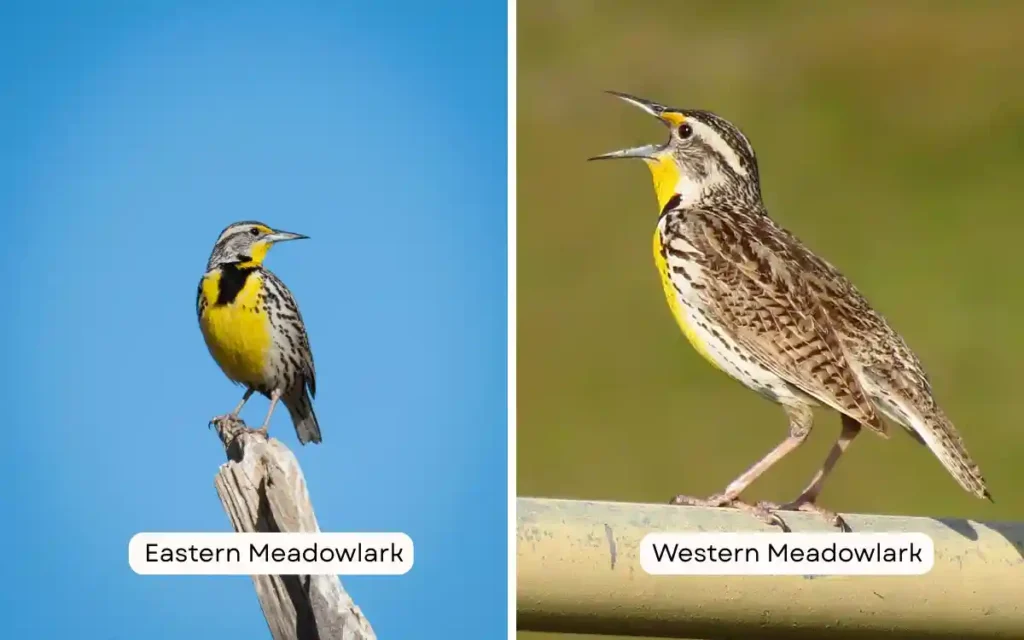
Quick Difference Table
| Feature | Eastern Meadowlark | Western Meadowlark |
| Best ID clue | Clearer, simpler whistle song | Richer, more flute-like song |
| Range | Eastern and parts of central North America | Western and central North America |
| Face pattern | Usually whiter mustache stripe | More yellow near lower bill |
| Tail in flight | Often slightly more white | Usually less white than Eastern |
| Habitat preference | Often taller, lusher grass in overlap areas | Often drier, more open grassland |
| Chest mark | Yellow chest with black V | Yellow chest with black V |
| Family | Blackbird family | Blackbird family |
| Feeder bird? | No | No |
Eastern Meadowlark
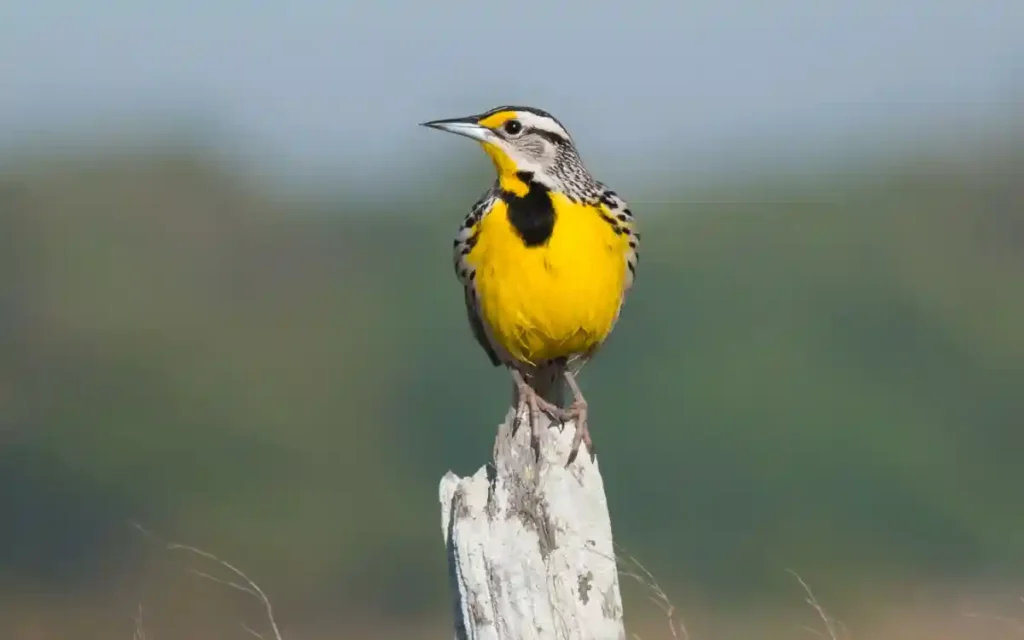
Quick ID: Yellow chest with a black V, brown streaked back, and clear whistled song.
What It Looks Like:
Eastern Meadowlarks have bright yellow underparts, a bold black V across the chest, brown streaked upperparts, and a long pointed bill. Their outer tail feathers show white in flight, and their head has dark and pale striping.
Where You’ll Find It:
Look for Eastern Meadowlarks in open fields, pastures, meadows, prairies, hayfields, and weedy grasslands. Audubon notes that in the Midwest, Eastern Meadowlarks tend to use taller and lusher grass than Western Meadowlarks.
Behavior Clues:
They often walk through grass while feeding, then fly up to a fence post, wire, or low perch to sing. They are ground-nesting birds, so they depend heavily on healthy grassland habitat.
How to Tell It Apart:
Song is the best clue. Eastern Meadowlarks usually sound clearer and more whistled. If the bird is silent, look for a mostly white mustache stripe and slightly more white in the tail during flight.
Best Time to See:
Spring and early summer are best because males sing from exposed perches.
Backyard Tip:
This is not a feeder bird. To see one, visit grasslands, rural fields, pastures, and open country.
Western Meadowlark
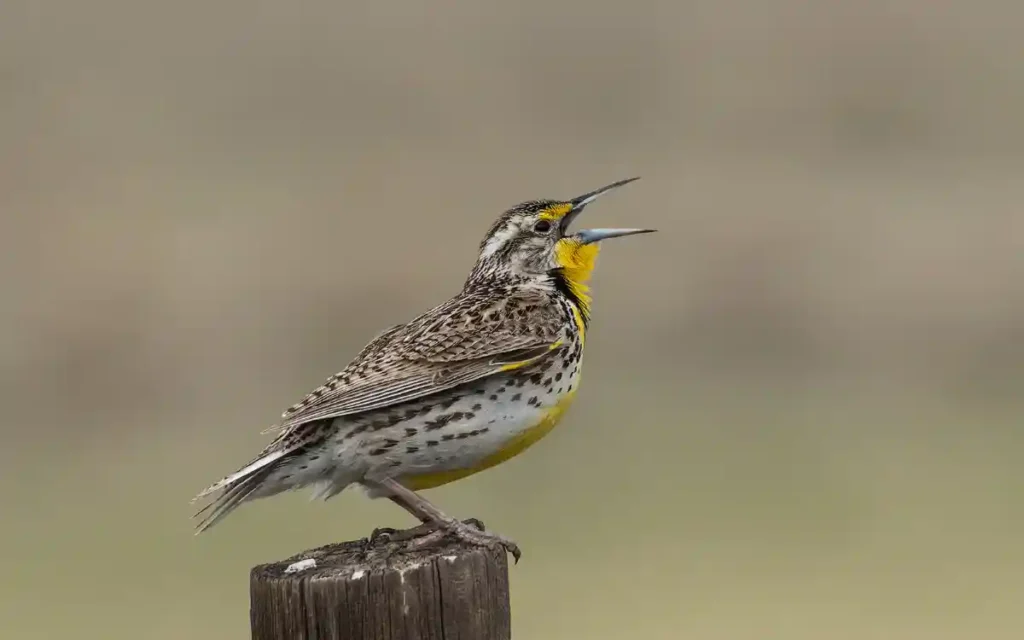
Quick ID: Yellow chest with black V, brown streaked back, and rich flute-like song.
What It Looks Like:
Western Meadowlarks look very similar to Eastern Meadowlarks. They have yellow underparts, a black V on the chest, streaked brown upperparts, white outer tail feathers, and a long pointed bill. Audubon describes Western Meadowlarks as robin-sized birds with a yellow breast, black V, and white outer tail feathers that show best on takeoff and landing.
Where You’ll Find It:
Look for Western Meadowlarks in western and central grasslands, prairies, ranchland, fields, open country, and dry grassy areas.
Behavior Clues:
They often sing from fence posts, wires, shrubs, or low perches. Their song is one of the most helpful field marks because it sounds richer and more musical than the Eastern Meadowlark’s song.
How to Tell It Apart:
Voice and range are the best clues. If the bird is silent, look for more yellow extending into the malar area near the lower bill and usually less white in the tail than Eastern Meadowlark.
Best Time to See:
Spring and early summer are best when males are singing in open country.
Backyard Tip:
This bird needs open grassland. You are more likely to find it on rural roads, prairie trails, ranchland, and open fields than in a normal backyard.
Fast ID: Which Meadowlark Did You See?
| What You Noticed | More Likely Bird |
| Clear, simple whistled song | Eastern Meadowlark |
| Rich, rolling, flute-like song | Western Meadowlark |
| Mostly eastern location | Eastern Meadowlark |
| Mostly western location | Western Meadowlark |
| Taller, lusher grass in overlap zone | Eastern Meadowlark |
| Drier, more open grassland in overlap zone | Western Meadowlark |
| Whiter mustache stripe | Eastern Meadowlark |
| Yellow extends higher near lower bill | Western Meadowlark |
| Slightly more white in tail in flight | Eastern Meadowlark |
| Silent bird in overlap range | Often best left as “meadowlark species” unless details are clear |
Biggest Difference: Song
For most birders, song is the most reliable difference.
Eastern Meadowlark: clearer, simpler whistles.
Western Meadowlark: richer, more musical, flute-like phrases.
This matters because their body patterns are so similar that a silent meadowlark can be very hard to identify with confidence.
Range Difference
Range is the second best clue.
Eastern Meadowlark: more expected in the eastern United States and parts of central North America.
Western Meadowlark: more expected in the western and central United States, western Canada, and parts of Mexico.
In the central Great Plains and some other overlap areas, both can occur. In those places, song becomes much more important.
Face Pattern Difference
If the bird is close enough or you have a photo, check the malar area, also called the mustache stripe.
Eastern Meadowlark: usually shows a mostly white mustache stripe.
Western Meadowlark: often shows yellow extending higher near the lower bill.
This is useful, but it is not as easy as song.
Tail Pattern Difference
Tail pattern can help when the bird flies.
Eastern Meadowlarks usually show slightly more white in the tail than Western Meadowlarks. Cornell lists this as one of the silent-bird clues, along with the face pattern.
Still, this can be hard to judge unless you get a clear flight view.
Common Mistakes
Mistake 1: Identifying by the black V only
Both species have a yellow chest with a black V, so that mark does not separate them.
Mistake 2: Ignoring the song
Song is often the best clue. A silent bird in overlap areas can be difficult, even for experienced birders.
Mistake 3: Assuming all meadowlarks in the East are Eastern
That is usually a good starting point, but always check range maps and local records if you are near overlap zones.
Mistake 4: Expecting one perfect visual mark
The face and tail clues help, but they are subtle. Use several clues together: song, range, habitat, face pattern, and tail pattern.
Simple Memory Trick
Use this:
Eastern = clearer whistles, whiter mustache.
Western = richer song, yellower mustache.
That will help with most field situations.
FAQs
Are Eastern and Western Meadowlarks the same bird?
No. They are separate species, even though they look very similar. Cornell notes that they hybridize only rarely, usually near the edge of their ranges.
What is the easiest way to tell Eastern and Western Meadowlarks apart?
The easiest way is by song. Eastern Meadowlarks usually have clearer whistles, while Western Meadowlarks have richer, flute-like songs.
Which meadowlark has more yellow on the face?
Western Meadowlarks often show more yellow extending into the malar area near the lower bill. Eastern Meadowlarks usually show a whiter mustache stripe.
Which meadowlark has more white in the tail?
Eastern Meadowlarks usually show slightly more white in the tail during flight than Western Meadowlarks, but this can be hard to judge quickly.
Do meadowlarks come to bird feeders?
No, not usually. Meadowlarks are grassland birds. They are more likely to be seen in fields, pastures, prairies, and open country.
Are meadowlarks actually larks?
No. Despite the name, meadowlarks are in the blackbird family, not the true lark family. Cornell notes that Eastern Meadowlark belongs to the blackbird family, which also includes orioles and cowbirds.
