
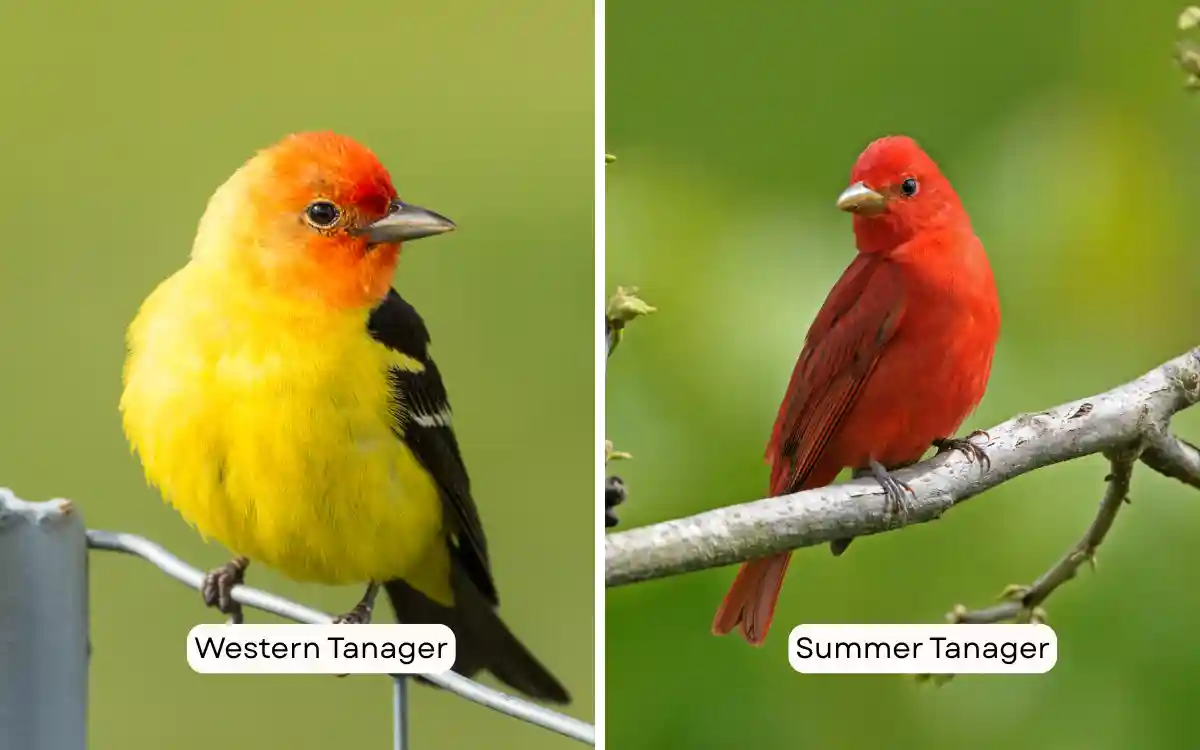
Western Tanagers and Summer Tanagers can confuse birders because both are medium-sized songbirds with bright warm colors. The males are easier: Western Tanager males have a yellow body, black wings, and a red-orange head, while Summer Tanager males are fully red with no black wings.
Females and young birds are trickier. Female Western Tanagers are yellow-green with darker wings and wing bars. Female Summer Tanagers are more plain yellow-green with a pale bill and usually lack strong dark wing contrast. Cornell describes adult male Western Tanagers as yellow birds with black wings and an orange-red head, while adult male Summer Tanagers are entirely bright red and females are bright yellow-green.
If you only remember one thing, remember this: black wings point toward Western Tanager; smooth red or smooth yellow-green points toward Summer Tanager.
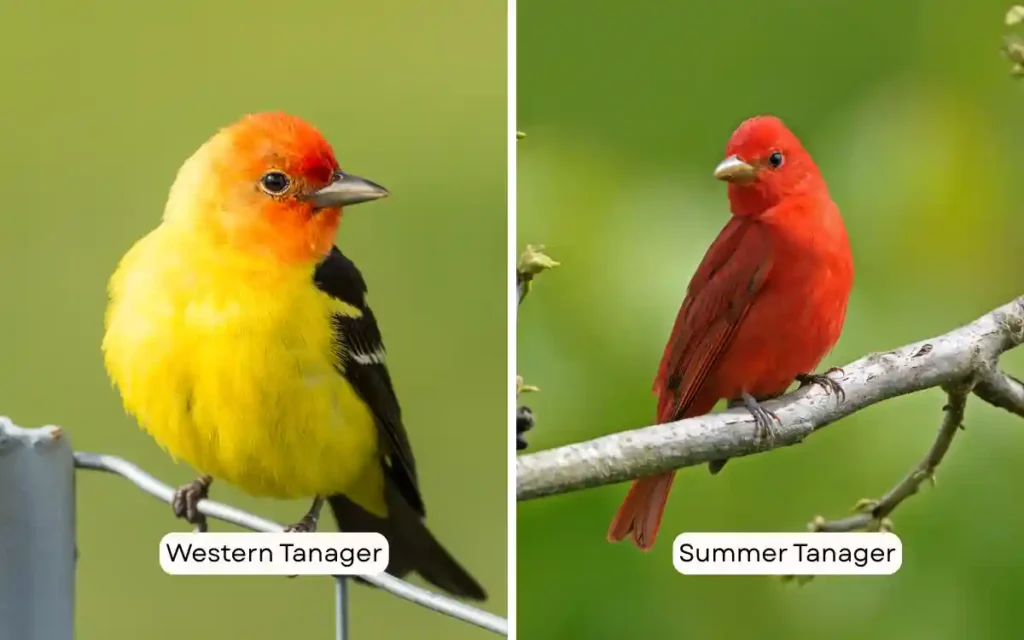
Quick Difference Table
| Feature | Western Tanager | Summer Tanager |
| Adult male color | Yellow body, red-orange head, black wings | Entirely red |
| Female color | Yellow-green with darker wings and wing bars | Yellow-green, smoother and plainer |
| Wing pattern | Strong black wings, two wing bars | No bold black wings |
| Bill | Medium, pale, fairly stout | Large, thick, blunt-tipped |
| Range | Mostly western North America | Mostly southern/eastern U.S. and Southwest |
| Habitat | Western forests, especially conifers and mixed woods | Open woods, forest edges, pine-oak woods |
| Behavior | Often in canopy, may be hidden | Sits and sallies for bees, wasps, and insects |
| Best clue | Black wings on male | Solid red male or plain yellow-green female |
Western Tanager
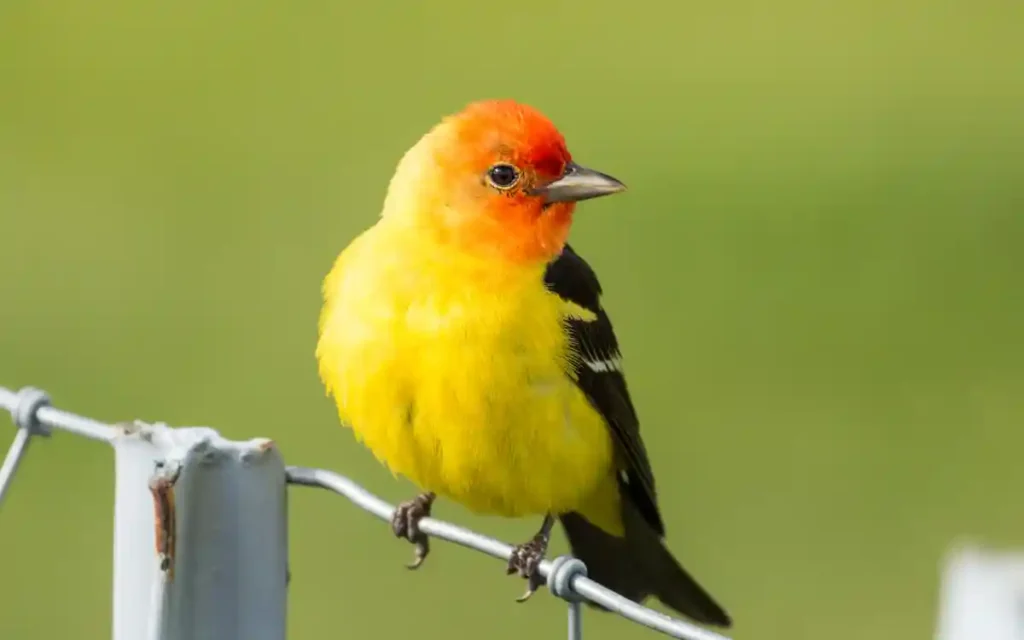
Quick ID: Yellow body, black wings, white/yellow wing bars, and red-orange head on males.
What It Looks Like:
Male Western Tanagers are one of the easiest tanagers to recognize when seen well. They have a bright yellow body, black back, black wings, black tail, and a red-orange head. The wings often show two wing bars, with yellow above and white below. Females are duller yellow-green with darker wings and pale wing bars.
Where You’ll Find It:
Western Tanagers are mostly birds of western North America. Look for them in open woods, conifer forests, mixed forests, mountain woods, parks, and wooded edges during migration.
Behavior Clues:
They often stay high in trees, so you may hear them before you see them. During migration, they may appear in yards, fruiting trees, or near water.
How to Tell It Apart:
The black wings are the strongest clue. Summer Tanagers do not have the same bold black wings. If the bird is yellow with black wings and a red-orange head, it is a Western Tanager, not a Summer Tanager.
Best Time to See:
Spring and summer are best in western breeding areas. Migration can bring them through parks and yards.
Backyard Tip:
Plant native fruiting shrubs, keep mature trees, and provide clean water. They are not typical seed-feeder birds.
Summer Tanager
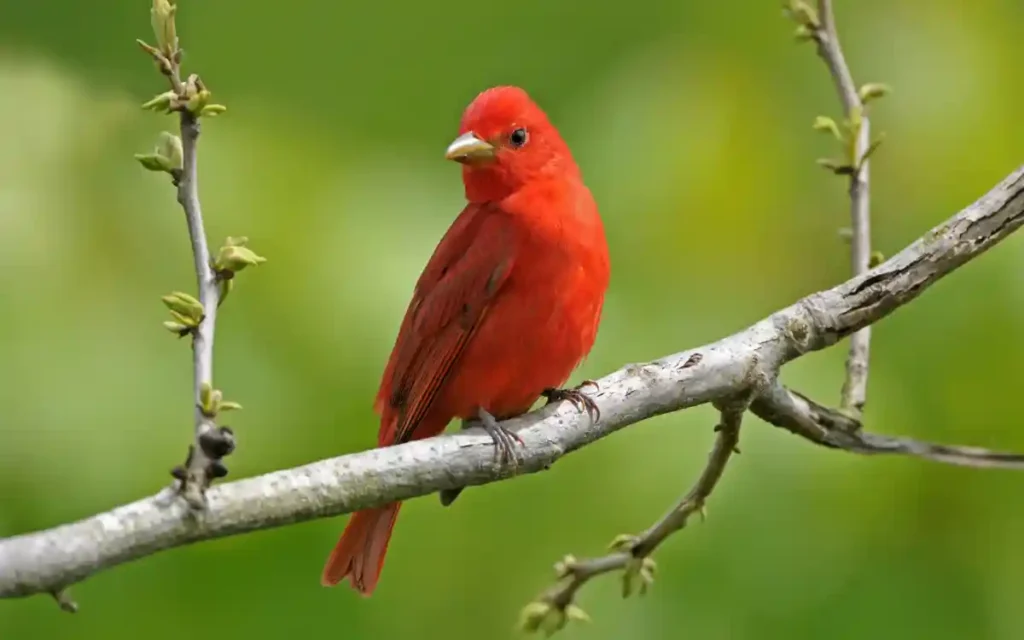
Quick ID: Adult male is fully red; female is yellow-green with a pale thick bill.
What It Looks Like:
Male Summer Tanagers are entirely bright red, without black wings. Females and immature males are yellow-green, usually yellower on the head and underparts and slightly greener on the back and wings. Young males may look patchy red and yellow as they molt. Cornell notes that Summer Tanagers have large, thick, blunt-tipped bills.
Where You’ll Find It:
Summer Tanagers breed around open forests, forest gaps, deciduous woods, mixed pine-oak woods, and wooded edges. In the Southwest, they may be found near streams with willows, cottonwoods, mesquite, or saltcedar.
Behavior Clues:
They often stay in the canopy and move more slowly than many small birds. Summer Tanagers are well known for catching bees and wasps in flight. Cornell notes that they beat bees against branches and rub them to remove the stinger before eating.
How to Tell It Apart:
If the bird is an adult male and looks completely red, it is a Summer Tanager. If it is female or immature, look for the smooth yellow-green body, pale bill, and lack of bold black wings.
Best Time to See:
Spring and summer are best in breeding areas. They migrate south for winter, with many birds leaving breeding grounds in September and October.
Backyard Tip:
They do not usually come to seed feeders. Native berry bushes, fruit trees, mature trees, and insect-rich habitat are more useful.
Fast ID: Which Tanager Did You See?
| What You Saw | More Likely Bird |
| Yellow body with black wings | Western Tanager |
| Red-orange head with yellow body | Western Tanager |
| Entirely red male | Summer Tanager |
| Yellow-green female with dark wings and wing bars | Western Tanager |
| Smooth yellow-green female with pale bill | Summer Tanager |
| Bird in western conifer forest | Western Tanager |
| Bird in southern open woods | Summer Tanager |
| Bird catching bees or wasps | Summer Tanager |
| Patchy red-and-yellow young male | Summer Tanager |
| Yellow bird with strong wing bars | Western Tanager |
Biggest Difference: Male Color
Adult males are the easiest.
Western Tanager male: yellow body, black wings, red-orange head.
Summer Tanager male: fully red body, no black wings.
This is the fastest way to separate them when the bird is a bright adult male.
Female Western Tanager vs Female Summer Tanager
Females are where most people get confused.
| Feature | Female Western Tanager | Female Summer Tanager |
| Body color | Yellow-green | Yellow-green |
| Wings | Darker, often with wing bars | Smoother, less contrast |
| Bill | Stout but not as heavy | Pale, thick, blunt-tipped |
| Overall look | More patterned | More plain |
| Best clue | Dark wings and wing bars | Pale bill and smooth body |
My opinion: for females, wing contrast is the best quick clue. If the wings look dark and marked, think Western. If the bird looks smoother yellow-green with a pale heavy bill, think Summer.
Range Difference
Range helps a lot.
Western Tanager: mostly western North America, especially western forests and mountain areas.
Summer Tanager: more common in the southern and eastern United States, with range also reaching parts of the Southwest.
There can be overlap in some western and southwestern areas, so range should not be your only clue. Use it with wing pattern, bill shape, and behavior.
Habitat Difference
Western Tanagers are strongly tied to western forests, especially coniferous and mixed woods. Cornell describes them as birds of open woods across the West, especially among evergreens.
Summer Tanagers prefer open forests, deciduous woods, mixed pine-oak woodlands, and wooded edges. In the Southwest, streamside trees can be good places to look.
Behavior Difference
Western Tanagers often stay hidden in the canopy and may be easier to notice by sound or during migration.
Summer Tanagers also use the canopy, but their insect-hunting behavior is useful. They often sally out to catch flying insects and are especially known for eating bees and wasps.
Common Mistakes
Mistake 1: Thinking a red-headed yellow bird is a Summer Tanager
A red-orange head with a yellow body and black wings is Western Tanager, not Summer Tanager.
Mistake 2: Calling every red tanager a Scarlet Tanager
Summer Tanager males are fully red. Scarlet Tanager males have black wings. Western Tanager males have yellow bodies and black wings.
Mistake 3: Ignoring female birds
Female tanagers are often harder than males. Look closely at the wings and bill instead of only using body color.
Mistake 4: Using color alone in poor light
Canopy light can change how yellow, orange, or red a bird looks. Check structure, wing pattern, and range.
Simple Memory Trick
Use this:
Western Tanager = western forests, yellow body, black wings.
Summer Tanager = summer woods, solid red male, plain yellow-green female.
FAQs
Are Western Tanagers and Summer Tanagers the same bird?
No. They are separate tanager species. Western Tanagers usually show yellow bodies and black wings, while male Summer Tanagers are fully red.
Which tanager is yellow with a red head?
That is usually a Western Tanager, especially if the bird also has black wings.
Which tanager is completely red?
The male Summer Tanager is completely red. Cornell describes it as the only completely red bird in North America.
How do you tell female Western and Summer Tanagers apart?
Female Western Tanagers usually show darker wings and wing bars. Female Summer Tanagers look smoother yellow-green and have a pale, thick bill.
Do Western Tanagers come to feeders?
They do not usually come to seed feeders, but they may visit fruiting trees, water, or sometimes backyard fruit during migration.
Do Summer Tanagers eat bees?
Yes. Summer Tanagers are known for catching bees and wasps and removing the stingers before eating them.
