
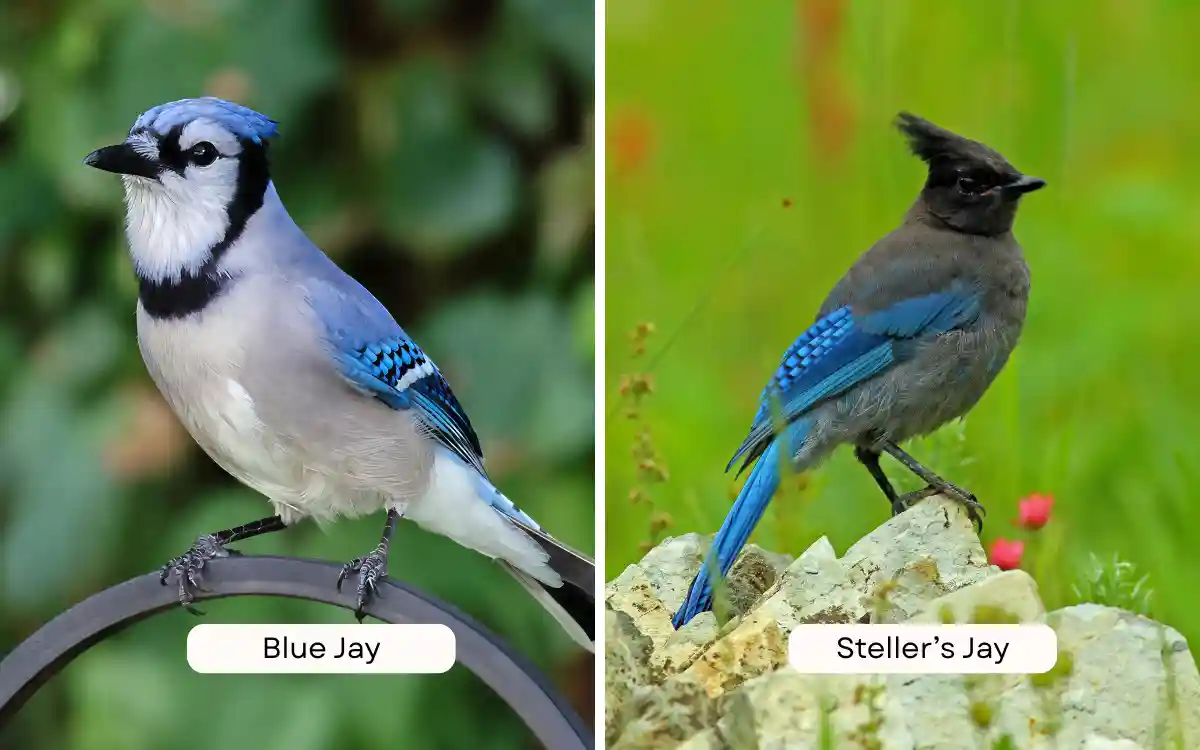
Blue Jays and Steller’s Jays are easy to confuse because both are blue, crested, loud, smart, and part of the crow family. But once you know where each bird lives and what the head looks like, the ID becomes simple.
A Blue Jay is mostly found in eastern and central North America. It has a blue back, white or pale gray underside, black necklace, white wing markings, and a blue crest. Cornell describes Blue Jays as large crested songbirds with blue, black, and white above and white or light gray below.
A Steller’s Jay is mostly a western bird. It has a dark charcoal or blackish head and upper body with blue lower body, wings, and tail. Cornell describes Steller’s Jays as hefty crested birds that are “half charcoal black and half blue.”
The simple difference is this: Blue Jays are blue, white, and black eastern jays, while Steller’s Jays are darker western jays with blackish heads and blue bodies.
Blue Jay Overview
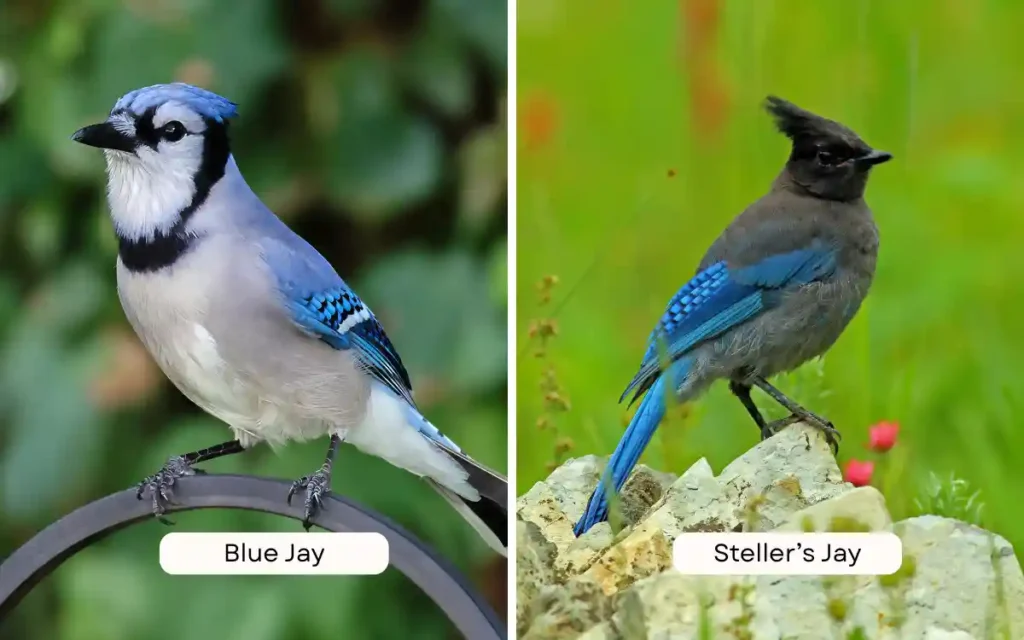
The Blue Jay is the bird many people picture when they hear “blue jay.” It has a blue crest, blue back, white or pale gray underside, black necklace, and blue wings and tail with black-and-white markings.
Blue Jays are loud and easy to notice. Cornell says they are often detected by their noisy calls and can be seen at feeders, in towns, and in wooded areas.
Main Blue Jay traits
| Trait | What It Means |
| Blue crest | Raised or lowered depending on mood |
| White underside | Easy way to separate from Steller’s Jay |
| Black necklace | Strong dark line around face and throat |
| Blue wings and tail | Marked with black and white |
| Strong bill | Good for seeds, nuts, acorns, and insects |
| Feeder behavior | Bold and often noisy |
Blue Jays are strongly linked with oak and beech trees. Audubon notes that Blue Jays favor oak or beech habitat and are often common in well-wooded suburbs and city parks.
Steller’s Jay Overview
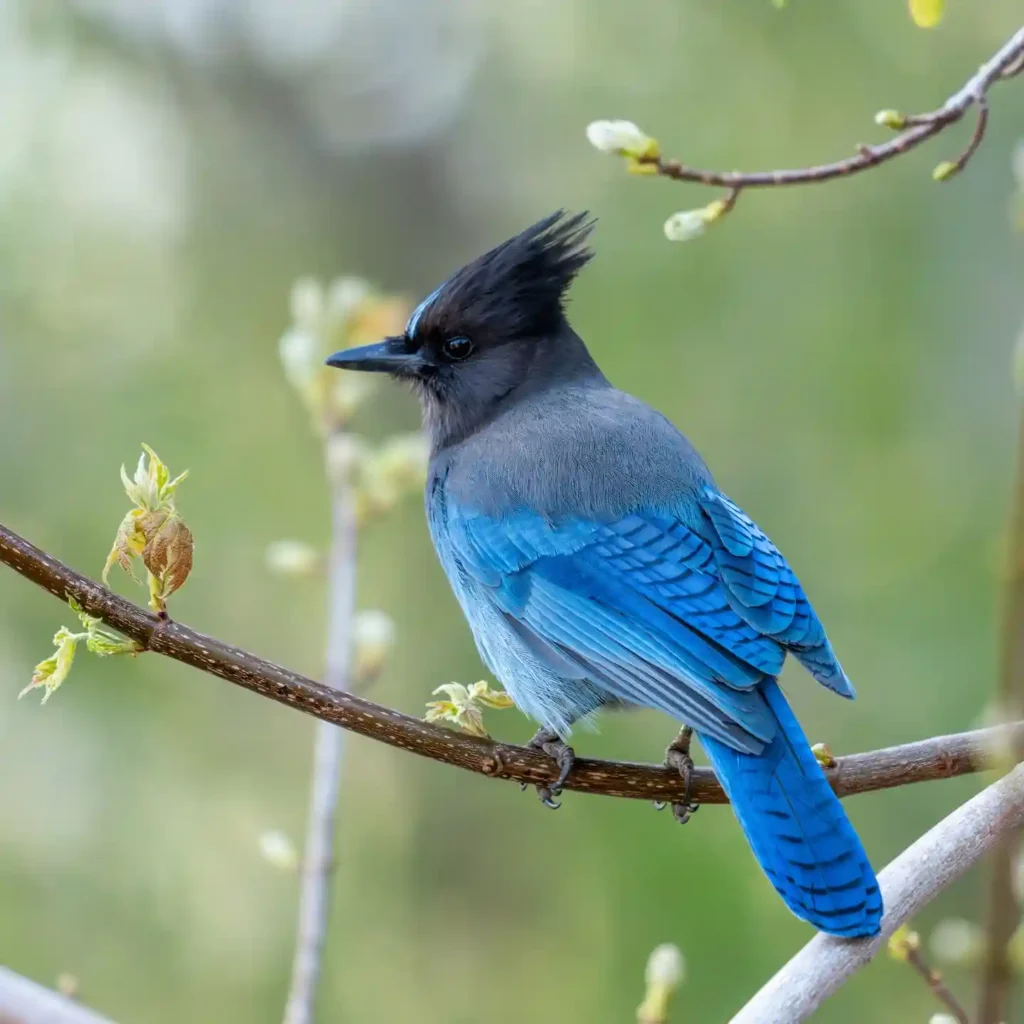
The Steller’s Jay is the darker western cousin people often call a “blue jay” in the western United States. It is blue, but not in the same way as a true Blue Jay.
A Steller’s Jay has a dark head, dark crest, dark chest, and blue wings, belly, and tail. Coastal birds may show blue streaks on the crest, while some interior birds show pale marks on the forehead.
Cornell’s ID guide describes Steller’s Jay as a hefty, crested bird with dark upper parts and blue lower parts.
Main Steller’s Jay traits
| Trait | What It Means |
| Dark crest | Usually black, charcoal, or dark blue |
| Dark head and chest | Main difference from Blue Jay |
| Blue wings and tail | Rich blue, often darker than Blue Jay |
| Forest bird | Strongly tied to western conifer forests |
| Bold behavior | Visits campsites, picnic areas, and feeders |
| Loud voice | Harsh calls and mimicry |
Steller’s Jays are especially common in western mountain forests, conifer woods, campgrounds, and forested neighborhoods.
Blue Jay vs Steller’s Jay: Appearance
Appearance is the fastest way to separate these birds if you get a clear view.
A Blue Jay looks brighter and more patterned. It has a white or pale underside, blue upperparts, white face, black necklace, and clear black-and-white wing markings.
A Steller’s Jay looks darker and heavier. It has a blackish or charcoal head, dark crest, dark upper body, and blue lower body.
| Body Part | Blue Jay | Steller’s Jay |
| Crest | Blue | Black, charcoal, or dark blue |
| Face | White with black markings | Dark face |
| Throat | White or pale with black necklace | Dark throat/chest |
| Back | Blue | Dark upper back, blue lower body |
| Belly | White or light gray | Blue |
| Wings | Blue with black and white marks | Blue, darker overall |
| Tail | Blue with barring | Blue |
Fast ID tip
If the jay has a white belly and black necklace, it is a Blue Jay.
If the jay has a dark head and blue body, it is a Steller’s Jay.
Blue Jay vs Steller’s Jay: Range
Range is one of the best clues because these birds mostly live in different parts of North America.
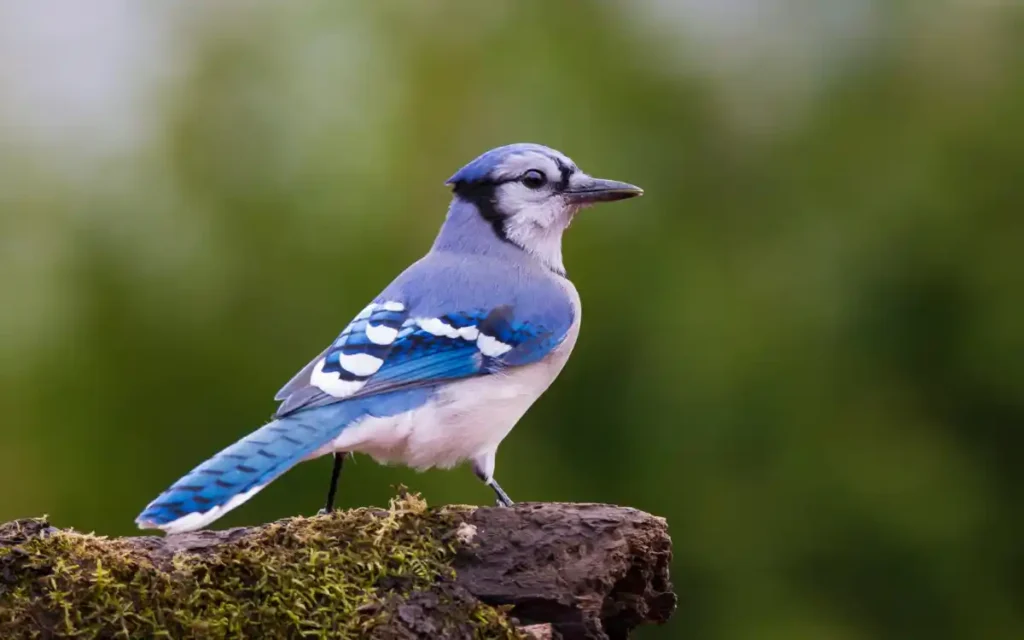
Blue Jays are mainly eastern and central birds. Steller’s Jays are western birds. BirdNote also explains that the Steller’s Jay is blue but is not a true Blue Jay with a capital “B,” since the true Blue Jay is mainly an eastern bird.
| Region | More Likely Bird |
| Eastern United States | Blue Jay |
| Midwest | Blue Jay |
| Southeast | Blue Jay |
| Pacific Northwest | Steller’s Jay |
| Rocky Mountains | Steller’s Jay |
| California mountains | Steller’s Jay |
| Western conifer forests | Steller’s Jay |
There can be limited overlap or unusual sightings, but for most backyard birders, location solves the question quickly.
Blue Jay vs Steller’s Jay: Habitat
Blue Jays are often found in deciduous or mixed woods, oak woods, parks, suburbs, towns, and city edges. They do well around people if trees and food are nearby.
Steller’s Jays are more western forest birds. They are strongly tied to coniferous forests, pine-oak woodlands, mountain forests, and forested neighborhoods. One field resource notes that Steller’s Jays are common in pine-oak woodlands and coniferous forests.
| Habitat | Blue Jay | Steller’s Jay |
| Oak woods | Common | Less typical |
| Deciduous forest | Common | Less typical |
| Mixed woods | Common | Sometimes |
| Conifer forest | Sometimes | Very common |
| Mountain forest | Less typical | Common |
| Suburban yards | Common | Common in western wooded areas |
| Campgrounds | Sometimes | Very common in western forests |
Direct ID clue: A jay in an eastern oak suburb is probably a Blue Jay. A jay in a western pine forest or mountain campground is probably a Steller’s Jay.
Blue Jay vs Steller’s Jay: Crest
Both birds have crests, but the crests look different.
Blue Jays have a blue crest that blends with their blue-and-white head pattern. Steller’s Jays have a taller-looking dark crest that often gives them a bolder, more rugged profile.
| Crest Feature | Blue Jay | Steller’s Jay |
| Color | Blue | Black, charcoal, or dark blue |
| Shape | Pointed but neat | Often taller and darker |
| Face contrast | White face and black necklace | Dark face and crest |
| Mood clue | Raised when alert | Also raised when alert |
If you only see the bird’s head, the crest color helps. A blue-and-white crested head points to Blue Jay. A black-crested head points to Steller’s Jay.
Blue Jay vs Steller’s Jay: Size
Both are fairly large jays. Blue Jays measure about 9.8–11.8 inches long, with a wingspan of about 13.4–16.9 inches, according to Cornell.
Steller’s Jays are also large, chunky birds. In the field, they often look heavier because of their dark head, tall crest, and bold posture.
| Size Feature | Blue Jay | Steller’s Jay |
| Overall size | Large jay | Large jay |
| Body look | Long-tailed and patterned | Hefty and darker |
| Head | Crested, patterned | Crested, dark, bold |
| Field impression | Bright and clean | Dark and dramatic |
Size alone is not the best difference. Use color and range first.
Blue Jay vs Steller’s Jay: Calls
Both birds are noisy. Both can sound harsh, bold, and alarm-like.
Blue Jays make loud jay calls, screams, rattles, and many other sounds. They can also imitate hawks.
Steller’s Jays also make harsh calls and are known for varied vocal behavior. They may mimic other birds and produce rough calls in western forests.
| Sound Feature | Blue Jay | Steller’s Jay |
| Voice type | Loud, harsh, varied | Loud, harsh, varied |
| Common sound | Jay calls, screams, rattles | Rattles, harsh calls, mimicry |
| Where heard | Eastern woods and yards | Western forests and campsites |
| ID value | Helpful with range | Helpful with range |
Sound can help, but it is not as clean as color and range because both birds are noisy corvids.
Blue Jay vs Steller’s Jay: Diet
Both birds eat a wide mix of foods. They are omnivorous and opportunistic.
Blue Jays eat acorns, nuts, seeds, insects, fruit, and feeder foods. Their link with acorns is especially well known.
Steller’s Jays eat seeds, nuts, insects, berries, fruits, and human food scraps when available around campgrounds or picnic sites.
| Food | Blue Jay | Steller’s Jay |
| Acorns | Yes, strong link | Sometimes |
| Peanuts | Yes | Yes |
| Sunflower seeds | Yes | Yes |
| Insects | Yes | Yes |
| Berries | Yes | Yes |
| Human food scraps | Sometimes | Common around campsites |
| Suet | Sometimes | Sometimes |
Both birds are smart enough to remember food sources and return to productive feeders.
Blue Jay vs Steller’s Jay: Feeder Habits
Both jays can visit backyard feeders, but the bird you see depends heavily on region.
Blue Jays are common feeder birds in the East and Midwest. They often come for peanuts, sunflower seeds, suet, and platform feeders.
Steller’s Jays visit feeders in the West, especially in wooded or mountain areas. They are also common around campgrounds and cabins.
| Feeder Feature | Blue Jay | Steller’s Jay |
| Peanuts | Excellent | Excellent |
| Sunflower seeds | Good | Good |
| Suet | Sometimes | Sometimes |
| Platform feeder | Good | Good |
| Hopper feeder | Good | Good |
| Tube feeder | Less ideal | Less ideal |
| Ground feeding | Sometimes | Sometimes |
Best feeder tip: Use a platform feeder with peanuts if you want to attract jays. Jays are larger than many songbirds, so they prefer stable feeding spaces.
Blue Jay vs Steller’s Jay: Behavior
Both birds are bold, intelligent, and sometimes pushy. They may scatter smaller birds at feeders, watch humans closely, and give alarm calls when predators appear.
Blue Jays often move through eastern neighborhoods, parks, and oak woods in small groups or family parties.
Steller’s Jays often show up boldly in western forests, campgrounds, picnic areas, and mountain towns.
| Behavior | Blue Jay | Steller’s Jay |
| Bold at feeders | Yes | Yes |
| Loud alarm calls | Yes | Yes |
| Intelligent | Yes | Yes |
| Food caching | Yes | Yes |
| Campground visits | Sometimes | Very common in western forests |
| Small bird dominance | Often | Often |
My opinion: Blue Jays feel louder in suburban yards. Steller’s Jays feel bolder in mountain forests and campsites.
Blue Jay vs Steller’s Jay: Nesting
Both birds build cup nests in trees and use twigs and plant material. The exact nest location depends on habitat.
Blue Jays usually nest in trees or shrubs in wooded areas, suburbs, and parks.
Steller’s Jays nest in western forest habitats, often in conifers or forest-edge trees.
| Nesting Feature | Blue Jay | Steller’s Jay |
| Nest type | Cup nest | Cup nest |
| Nest site | Trees and shrubs | Trees, often conifers |
| Habitat | Eastern/mixed woods, suburbs | Western conifer forests |
| Parent behavior | Protective and noisy | Protective and noisy |
Both can be defensive near nesting areas, especially when people, cats, crows, hawks, or other threats get close.
Blue Jay vs Steller’s Jay: Are They Related?
Yes. Blue Jays and Steller’s Jays are closely related jays in the crow family. They belong to the same genus, Cyanocitta, which is why they share many traits: crests, blue feathers, loud calls, smart behavior, strong bills, and bold personalities.
That said, they are separate species with different ranges and field marks.
| Relationship Point | Answer |
| Same family? | Yes, crow family |
| Both jays? | Yes |
| Same species? | No |
| Same genus? | Yes |
| Main difference | Range and plumage |
Can Blue Jays and Steller’s Jays Hybridize?
Rarely, yes. Where their ranges meet or overlap, Blue Jays and Steller’s Jays can sometimes produce hybrids. This is not something most backyard birders will see, but it explains why a few birds may look “in between.”
If a jay has a mix of Blue Jay and Steller’s Jay features, especially near the Rocky Mountain region, a hybrid may be possible. For normal ID, though, most birds are straightforward.
Which Bird Did You See?
Use this quick guide:
| What You Saw | Likely Bird |
| Blue jay with white belly | Blue Jay |
| Blue jay with black necklace | Blue Jay |
| Blue jay in eastern backyard | Blue Jay |
| Dark-headed blue jay in western forest | Steller’s Jay |
| Jay at Pacific Northwest campsite | Steller’s Jay |
| Jay with black crest and blue body | Steller’s Jay |
| Jay with white face and blue crest | Blue Jay |
| Jay in oak-heavy eastern suburb | Blue Jay |
| Jay in conifer mountain forest | Steller’s Jay |
Common Mistakes
Calling every blue jay a Blue Jay
This is the biggest mistake. A “blue jay” can mean any jay that is blue in casual speech, but Blue Jay with capital letters is a specific species.
Ignoring location
Location often solves the ID. East usually points to Blue Jay. West usually points to Steller’s Jay.
Looking only at blue feathers
Both birds are blue. The head, belly, and face pattern matter more.
Confusing Steller’s Jay with Scrub-Jays
Western scrub-jays can also be blue, but they do not have the tall crest of a Steller’s Jay or Blue Jay.
FAQs
Is a Steller’s Jay the same as a Blue Jay?
No. A Steller’s Jay and a Blue Jay are separate species. Both are blue, crested jays, but Blue Jays are mainly eastern and central birds, while Steller’s Jays are mainly western birds.
What is the easiest way to tell a Blue Jay from a Steller’s Jay?
Check the head and belly. A Blue Jay has a white or pale belly and black necklace. A Steller’s Jay has a dark head and blue body.
Do Blue Jays and Steller’s Jays live in the same place?
Mostly no. Blue Jays are mainly eastern and central North American birds. Steller’s Jays are western birds, especially in conifer forests and mountain areas.
Which bird is darker, Blue Jay or Steller’s Jay?
The Steller’s Jay is much darker. It has a black, charcoal, or dark blue head and upper body. The Blue Jay looks lighter because it has a white face and pale underside.
Do Steller’s Jays come to feeders?
Yes. Steller’s Jays visit feeders in their western range, especially for peanuts, sunflower seeds, and suet.
Do Blue Jays and Steller’s Jays sound the same?
They can both sound harsh and loud, but their calls differ. In practice, range and appearance are usually easier than sound for beginners.
