
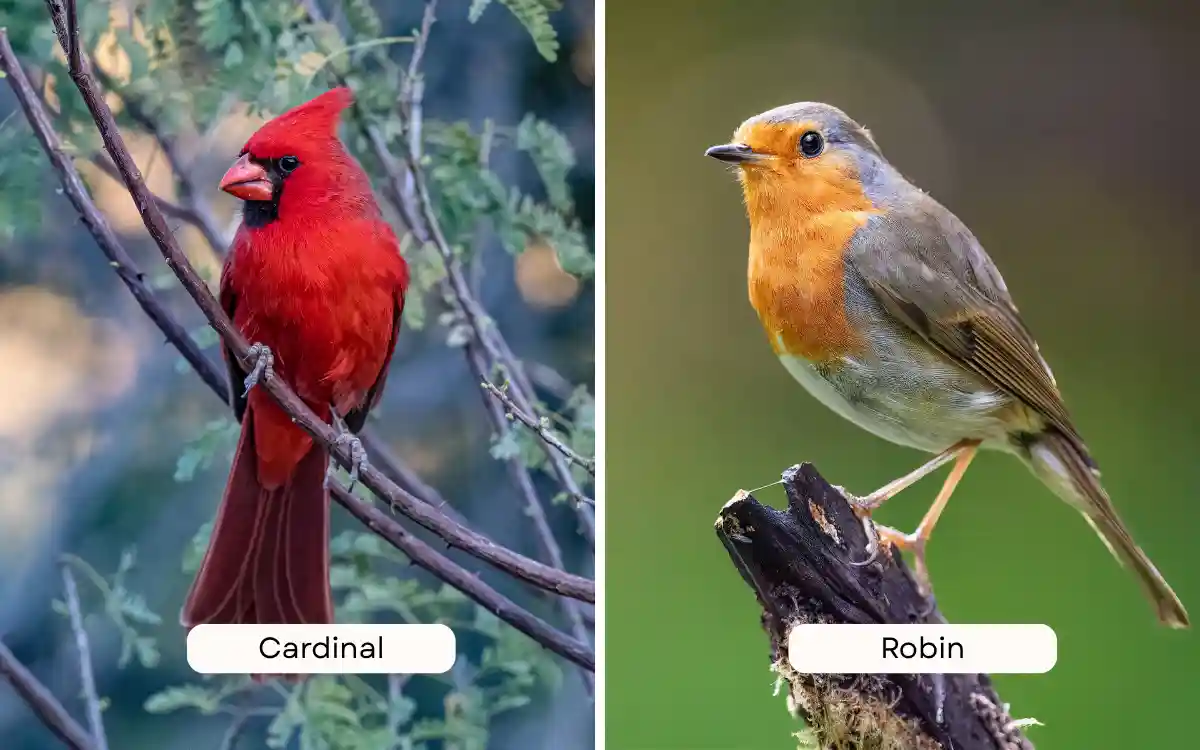
Cardinals and robins are two of the most familiar backyard birds in North America, but they are easy to separate once you know what to look for.
A Northern Cardinal is a crested songbird with a thick seed-cracking bill. Males are bright red with a black face mask, while females are warm brown with reddish wings, tail, and crest. Cornell describes Northern Cardinals as large, long-tailed songbirds with a short, very thick bill and a clear crest.
An American Robin is a thrush with a gray-brown back, orange breast, yellow bill, long legs, and ground-hopping behavior. Cornell describes American Robins as large, round-bodied songbirds with long legs and a fairly long tail, and notes they are the largest North American thrushes.
The simple difference is this: cardinals are crested seed-eaters with red or reddish-brown coloring, while robins are orange-breasted thrushes that often hop across lawns looking for worms.
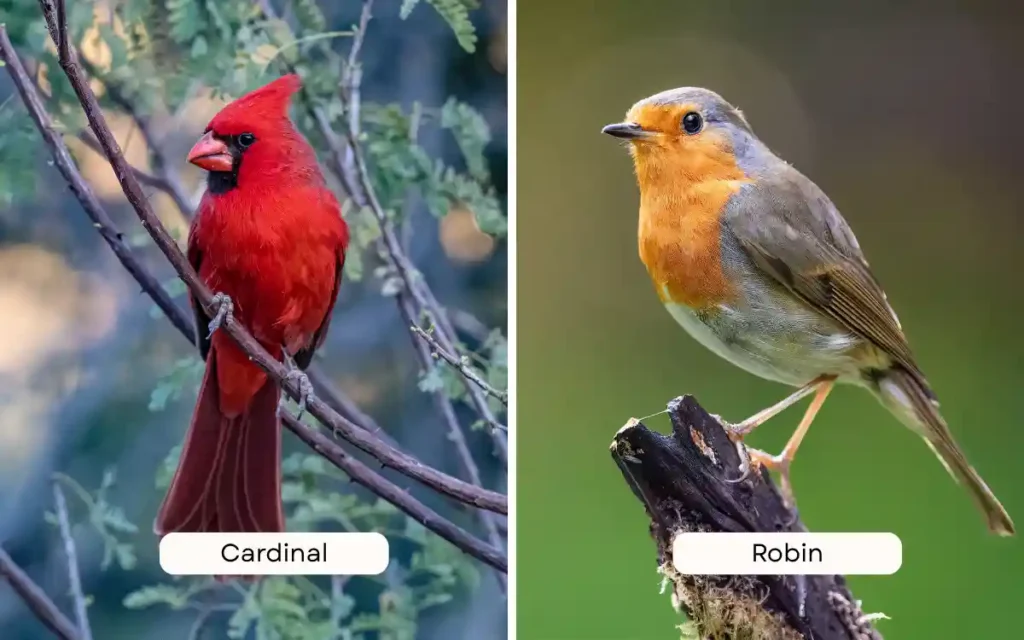
Cardinal Overview
The Northern Cardinal is one of the easiest birds to recognize, especially the male. He is bright red with a black mask around the bill and throat. The female is not plain, though. She has soft brown plumage with reddish tones in the crest, wings, and tail.
Audubon calls the male Northern Cardinal unmistakable and notes that the female also has a crest, a massive pink bill, and a long tail.
Main cardinal traits
| Trait | What It Means |
| Crest | Gives the head a pointed shape |
| Thick bill | Built for cracking seeds |
| Red male | Easy to spot in trees and snow |
| Brown female | Warmer and softer, with red accents |
| Black face mask | Strong mark on males |
| Feeder-friendly | Often visits sunflower and safflower feeders |
Cardinals often stay near shrubs, hedges, vines, and woodland edges. They like cover and often feed low or near the ground.
Robin Overview
The American Robin is a large thrush and one of the classic signs of spring for many people. It has a gray-brown back, dark head, orange or brick-red breast, white markings around the eye, and a yellow bill.
Cornell notes that American Robins are common on lawns across North America, where people often see them pulling earthworms from the ground.
Main robin traits
| Trait | What It Means |
| Orange breast | Main ID feature |
| Yellow bill | Easy clue on adults |
| Long legs | Helps with lawn-hopping |
| Round belly | Classic thrush shape |
| No crest | Smooth head, unlike cardinal |
| Ground feeding | Often seen hunting worms |
Robins are often more visible in open yards, parks, lawns, fields, and gardens. They also eat many berries, especially outside the breeding season.
You shoud know 10 Birds That Look Like Robins
Cardinal vs Robin: Appearance
Cardinals and robins look very different when seen clearly.
A cardinal has a crest, a thick cone-shaped bill, and a long tail. A male cardinal is red all over, while the female is brown with red highlights.
A robin has no crest, a yellow bill, a gray-brown back, and a large orange breast.
| Body Part | Cardinal | Robin |
| Head | Pointed crest | Smooth, rounded head |
| Face | Male has black mask | White eye marks and streaked throat |
| Bill | Thick and orange-red/pink | Slimmer and yellow |
| Chest | Red male; tan-brown female | Orange or brick-red |
| Back | Red male; brown female | Gray-brown |
| Tail | Long red or reddish-brown | Fairly long, dark gray-brown |
Fast ID tip
If the bird has a crest and thick orange bill, it is a cardinal.
If the bird has an orange breast, yellow bill, and no crest, it is a robin.
Cardinal vs Robin: Size
Robins are usually a little larger and taller-looking than cardinals. A robin has longer legs and a rounder belly. A cardinal looks more compact, with a heavier seed bill and longer tail.
| Size Feature | Cardinal | Robin |
| Overall size | Medium songbird | Larger thrush |
| Body shape | Compact, long-tailed | Round belly, long legs |
| Head | Crested | Smooth and rounded |
| Posture | Perched or low in shrubs | Upright, often on lawns |
| Field impression | Bold and colorful | Taller, ground-active |
Audubon lists Northern Cardinals at about 8–9 inches long, while American Robins are about 8–11 inches long.
Cardinal vs Robin: Color
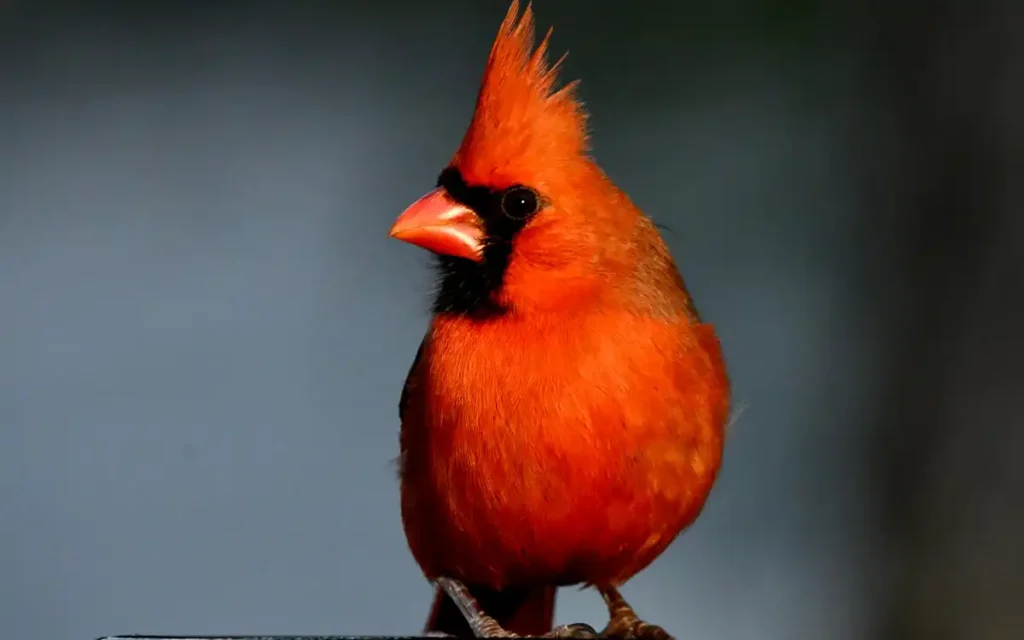
Color is the easiest difference.
Male cardinals are bright red. Female cardinals are brown with red accents. Robins are not fully red. They have an orange or brick-red breast with a gray-brown back.
| Color Feature | Cardinal | Robin |
| Male | Bright red | Gray-brown with orange breast |
| Female | Brown with red crest, wings, tail | Similar to male but often paler |
| Breast | Red or warm tan | Orange/brick-red |
| Back | Red or brown | Gray-brown |
| Face | Black mask on male | White eye marks, yellow bill |
A common beginner mistake is calling robins “red birds.” Their breast can look reddish-orange, but they do not have the full red body or crest of a cardinal.
Cardinal vs Robin: Bill Shape
The bill gives a strong clue.
Cardinals have short, thick, cone-shaped bills. These are perfect for cracking seeds.
Robins have slimmer, more pointed yellow bills. Their bills are better for grabbing worms, insects, and berries.
| Bill Feature | Cardinal | Robin |
| Shape | Thick cone | Slimmer and straighter |
| Color | Orange-red or pinkish | Yellow |
| Main use | Cracking seeds | Pulling worms, eating insects and fruit |
| Best clue | Looks heavy for the face | Looks sharper and longer |
Simple rule: thick orange bill means cardinal. Yellow worm-pulling bill means robin.
Cardinal Bird Spiritual Meaning: Signs, Love, Loss & Symbolism
Cardinal vs Robin: Behavior
Cardinals often stay near cover. They perch in shrubs, low trees, vines, and garden edges. They visit feeders often and may feed on the ground beneath them.
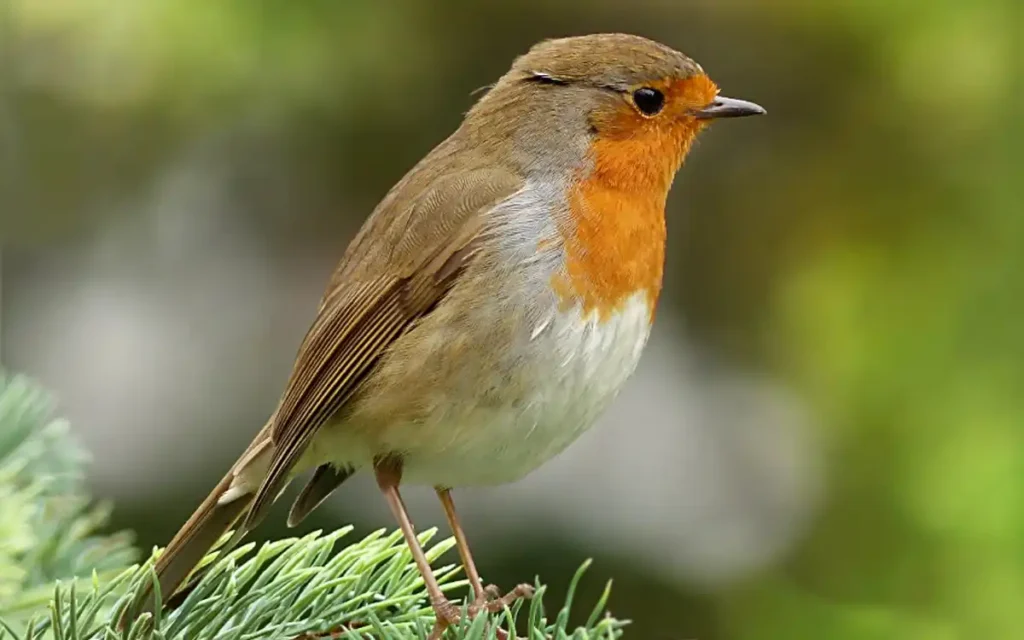
Robins are more open-ground birds. They hop across lawns, stop, tilt their heads, and pull worms from the soil. This “hop-stop-listen-look” behavior is one of the easiest robin clues.
| Behavior | Cardinal | Robin |
| Common movement | Perches, hops near shrubs/feeders | Hops across lawns |
| Feeding style | Cracks seeds, picks fruit | Pulls worms, eats insects and berries |
| Feeder habit | Very common | Less likely at seed feeders |
| Cover preference | Dense shrubs and edges | Lawns, open ground, trees |
| Social pattern | Often pairs or small groups | Can gather in larger flocks |
My opinion: cardinals are better feeder birds, but robins are easier to watch in open yards because they spend so much time on lawns.
Cardinal vs Robin: Diet
Cardinals are mainly seed and fruit eaters, though they also feed insects to their young.
Robins eat many worms and insects during warmer months, then switch heavily to berries and fruit at other times. Audubon describes the American Robin’s chest as brick-red and notes its classic thrush features, while Cornell highlights its common lawn behavior of tugging earthworms from the ground.
| Food | Cardinal | Robin |
| Sunflower seeds | Yes | Rarely main food |
| Safflower seeds | Yes | No |
| Worms | Not typical adult food | Yes |
| Insects | Yes, especially for young | Yes |
| Berries | Yes | Yes |
| Fruit | Yes | Yes |
| Feeder food | Seeds | Mealworms, fruit, berries |
Best backyard foods
For cardinals, offer black oil sunflower seeds and safflower.
For robins, offer mealworms, berry-producing shrubs, fruit pieces, and a clean birdbath. Robins usually do not care much about standard seed feeders.
Cardinal vs Robin: Sound
Both birds are vocal, but their songs feel different.
Cardinals sing clear, strong whistles. Their songs often sound like repeated phrases. Their sharp “chip” call is also common from shrubs.
Robins sing a bright, repeated song often described as cheerful. They are among the most noticeable morning singers in many neighborhoods.
| Sound Feature | Cardinal | Robin |
| Song style | Clear whistles | Cheerful repeated phrases |
| Common call | Sharp chip | Tut/tuk notes and alarm calls |
| Singing perch | Shrubs, small trees, edges | Trees, rooftops, lawns nearby |
| Best sound clue | Whistled phrases | Classic spring morning song |
If you hear a bird singing from a treetop before sunrise, it could easily be a robin. If you hear sharp chips from a shrub, check for a cardinal.
Cardinal vs Robin: Habitat
Cardinals like brushy places. They are common in backyards, parks, woodland edges, hedges, thickets, and gardens. Cornell notes that away from backyards, cardinals can be harder to see because they spend time in dense tangles.
Robins use more open ground. They are common on lawns, city parks, gardens, fields, forest edges, and wilder areas too. Cornell notes that robins are familiar in towns and cities but also occur in mountain forests and other wild habitats.
| Habitat | Cardinal | Robin |
| Shrubs and hedges | Excellent | Sometimes |
| Lawns | Sometimes | Excellent |
| Feeders | Excellent | Less common |
| Parks | Common | Common |
| Woodland edges | Common | Common |
| Dense tangles | Common | Less central |
| Open ground | Less typical | Common |
Cardinal vs Robin: Nesting
Cardinals usually nest in dense shrubs, vines, small trees, and thick cover. Their nest is often lower and hidden.
Robins build cup nests in trees, shrubs, and sometimes on human structures like ledges, gutters, lights, and porch areas. They use mud in the nest, which is a classic robin nesting clue.
| Nesting Feature | Cardinal | Robin |
| Nest site | Dense shrubs, vines, small trees | Trees, shrubs, ledges, structures |
| Nest height | Often lower and hidden | Varies, often visible |
| Nest material | Twigs, grasses, leaves | Grass, twigs, mud lining |
| Yard help | Thick shrubs | Trees, platforms, safer ledges |
| Egg color | Pale with markings | Famous blue eggs |
Cardinal vs Robin: Migration
Cardinals are mostly year-round residents in their range. They are especially loved in winter because the male’s red color stands out against snow and bare branches.
Robins are more variable. Many migrate, but some stay through winter when berries are available. Large winter robin flocks can appear in fruiting trees even when lawns are frozen.
| Migration Feature | Cardinal | Robin |
| Year-round presence | Common | Depends on region and food |
| Winter behavior | Stays near cover and feeders | May form berry-feeding flocks |
| Migration | Generally non-migratory | Many migrate, some overwinter |
| Winter food | Seeds, berries | Berries and fruit |
Cardinal vs Robin: Which Is Easier to Attract?
Cardinals are easier to attract with feeders. Give them black oil sunflower seeds, safflower, and a stable platform or hopper feeder.
Robins are easier to attract with habitat. They like open lawns, insects, berries, fruiting shrubs, and clean water.
| Backyard Feature | Helps Cardinal | Helps Robin |
| Sunflower feeder | Excellent | Not much |
| Safflower | Excellent | No |
| Mealworms | Sometimes | Good |
| Berry shrubs | Good | Excellent |
| Birdbath | Good | Excellent |
| Open lawn | Somewhat | Excellent |
| Dense shrubs | Excellent | Good for nesting/cover |
| Fruit trees | Good | Excellent |
Direct opinion: If your goal is feeder traffic, cardinal wins. If your goal is natural yard activity, robins are great because they hunt, bathe, nest, and raise young where you can see them.
Cardinal vs Robin: Symbolism
Many readers compare these birds because both are emotionally meaningful.
Cardinals are often linked with loved ones, hope, comfort, and signs from nature. Robins are often linked with spring, renewal, fresh starts, and the return of warmer days.
This is not bird science, but it is real reader intent. A short symbolism section can help keep readers on the page and create internal links.
| Bird | Common Symbolic Themes |
| Cardinal | Love, memory, comfort, hope |
| Robin | Spring, renewal, new beginnings, joy |
Quick ID Guide
| What You See | Likely Bird |
| Bright red bird with crest | Male cardinal |
| Brown bird with red wings and crest | Female cardinal |
| Orange-breasted bird hopping on lawn | Robin |
| Bird pulling worms from grass | Robin |
| Bird eating sunflower seeds at feeder | Cardinal |
| Bird with yellow bill and gray back | Robin |
| Bird with thick orange bill | Cardinal |
| Bird singing clear whistles from shrubs | Cardinal |
| Bird singing from treetop at dawn | Robin |
FAQs
Are cardinals and robins related?
No. Northern Cardinals are in the cardinal family, while American Robins are thrushes. They may share backyards, but they are different types of songbirds.
Which is bigger, a cardinal or a robin?
The American Robin is usually slightly larger and taller-looking than the Northern Cardinal. Robins also have longer legs and a rounder belly.
Do cardinals and robins eat the same food?
They overlap on fruit and insects, but their main foods differ. Cardinals eat more seeds, while robins eat more worms, insects, berries, and fruit.
Do robins visit bird feeders?
Robins usually do not visit standard seed feeders the way cardinals do. They are more likely to use birdbaths, eat mealworms, or feed on berries and fruit.
What bird is red like a cardinal but shaped like a robin?
A Summer Tanager or Scarlet Tanager may confuse people because of red coloring, but they do not have the cardinal’s crest or thick orange bill. A robin has an orange breast, not a fully red body.
Why do I see robins on the lawn but cardinals in shrubs?
Robins often hunt worms and insects in open grass. Cardinals prefer cover, so they stay closer to shrubs, hedges, vines, and feeder areas.
