
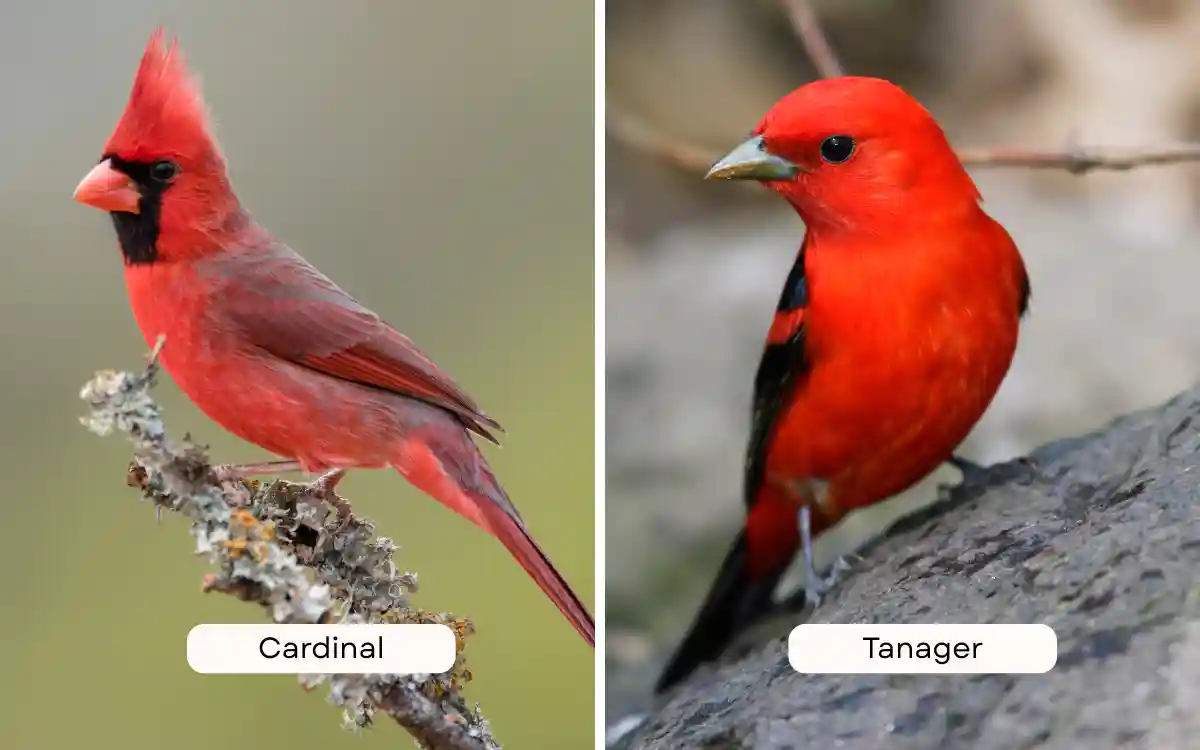
Cardinals and tanagers are often confused because both can be bright red. The confusion is strongest with male Northern Cardinals, male Summer Tanagers, and male Scarlet Tanagers.
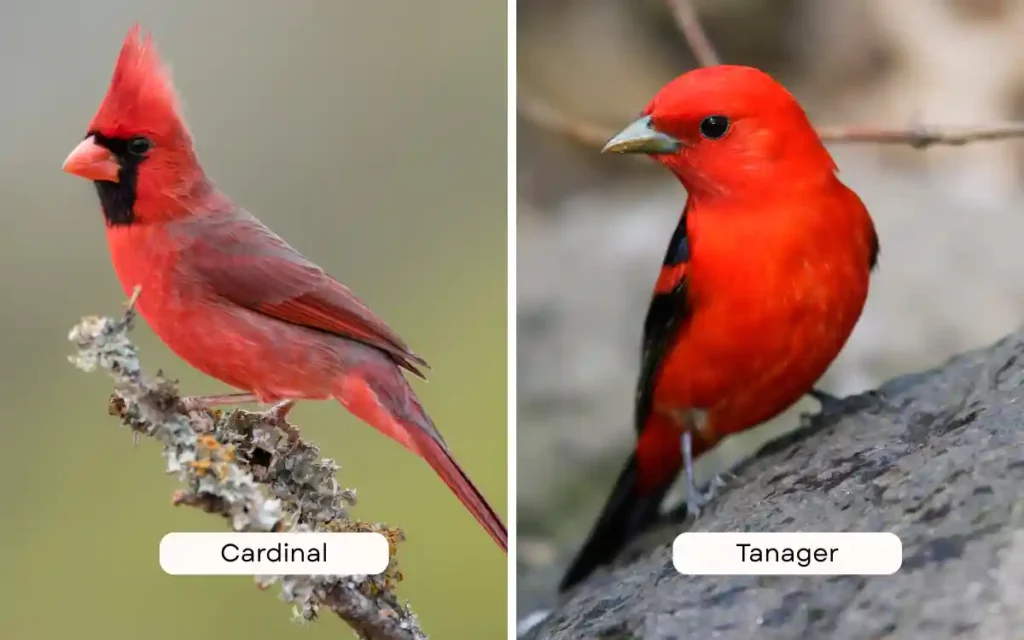
The simple difference is this: cardinals have a crest, thick orange-red bill, and black face mask, while tanagers usually have smooth heads, different bill shapes, and no cardinal-style crest.
A Northern Cardinal is a large, long-tailed songbird with a very thick bill, a clear crest, and, in males, a bright red body with a black mask and throat.
A Summer Tanager is a red songbird with a large blunt-tipped bill, but it does not have the strong crest or black face mask of a cardinal.
A Scarlet Tanager is even easier to separate in breeding plumage because the male has a red body with black wings and black tail.
Cardinal Overview
The Northern Cardinal is one of the easiest red birds to identify when seen clearly. The male is bright red with a black mask around the bill and throat. The female is pale brown with warm red tones in the wings, tail, and crest. Cornell describes both sexes as large, crested songbirds with short, thick bills.
Cardinals are common around backyards, parks, woodland edges, hedges, gardens, and thickets. They often visit feeders, especially for sunflower seeds and safflower.
Main cardinal traits
| Trait | What It Means |
| Crest | Pointed feathers on top of the head |
| Thick bill | Built for cracking seeds |
| Male black mask | Strong face mark around bill and throat |
| Long tail | Often visible when perched |
| Feeder habit | Common at backyard feeders |
| Female color | Brown with red accents, not yellow |
Best cardinal clue: crest plus thick orange-red bill.
Tanager Overview
Tanagers are colorful songbirds, but they are not all red. In North America, the two tanagers most often confused with cardinals are the Summer Tanager and Scarlet Tanager.
The Summer Tanager male is red overall. Houston Audubon notes that the male Summer Tanager is the only completely red bird in North America, while females are olive-green above and mustard yellow below.
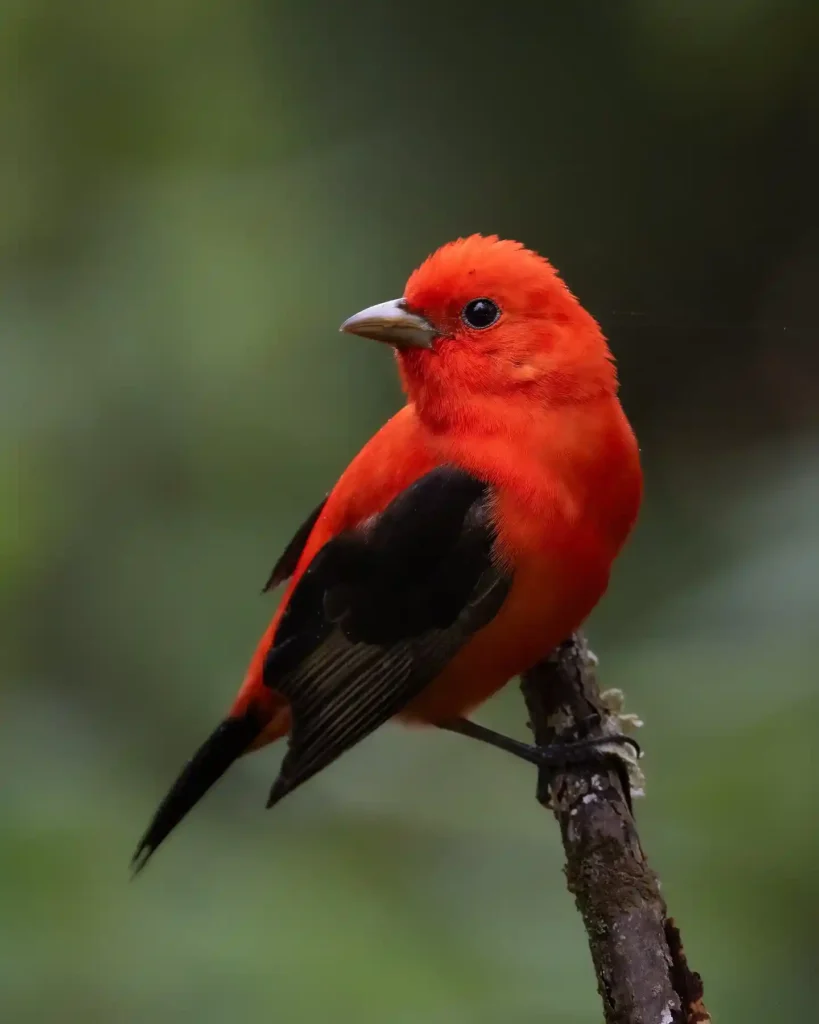
The Scarlet Tanager male has a red body with black wings and black tail. Cornell describes breeding males as bright red with black wings and tails.
Main tanager traits
| Trait | What It Means |
| No cardinal crest | Head usually looks smoother |
| No black cardinal mask | Face is cleaner than male cardinal |
| Forest-loving | Often higher in trees |
| Rare at feeders | Usually not regular seed-feeder birds |
| Insect-heavy diet | Many eat insects and fruit |
| Seasonal color changes | Some males change to yellow-green outside breeding season |
Best tanager clue: red bird with no crest and no black mask.
Cardinal vs Tanager: Appearance
Cardinals and tanagers can both be red, but their shape is different.
A cardinal looks sharper-headed because of its crest. It also has a heavy cone-shaped bill and long tail. A male cardinal has a black mask, which tanagers do not have.
A Summer Tanager looks smoother-headed and more evenly red. A Scarlet Tanager looks red with black wings and tail.
| Body Part | Cardinal | Tanager |
| Head | Crested | Smooth or only slightly raised |
| Face | Male has black mask | No cardinal-style black mask |
| Bill | Short, thick, orange-red | Blunt-tipped, usually not orange-red like cardinal |
| Wings | Red on male cardinal | Black on male Scarlet Tanager; red on male Summer Tanager |
| Tail | Long and red | Scarlet Tanager has black tail; Summer Tanager has red tail |
| Female | Brown with red accents | Yellow, olive, or greenish depending on species |
Fast ID tip
If the red bird has a crest and black mask, it is a cardinal.
If the red bird has no crest, check the wings.
If the wings are black, it is likely a Scarlet Tanager.
If the bird is red all over with no crest, it may be a Summer Tanager.

Cardinal vs Summer Tanager
This is the trickiest comparison because both males can look red overall.
A male cardinal is red, but it has a crest, black face mask, and thick orange-red bill. A male Summer Tanager is red without the cardinal’s pointed crest or black mask.
Cornell describes Summer Tanagers as medium-sized chunky songbirds with large heads and large blunt-tipped bills.
| Feature | Northern Cardinal | Summer Tanager |
| Male color | Bright red | Red overall |
| Crest | Yes | No true crest |
| Face | Black mask | Plain red face |
| Bill | Thick orange-red cone | Larger blunt bill |
| Feeder visits | Common | Rare |
| Usual view | Shrubs, feeders, edges | Trees, woods, canopy |
Best difference: Cardinal has crest and black mask. Summer Tanager is red but smoother-headed.
Cardinal vs Scarlet Tanager
This one is easier.
A male Scarlet Tanager has a red body with black wings and black tail. A male cardinal is red with red wings and red tail.
Cornell calls breeding male Scarlet Tanagers unmistakable because of their bright red bodies and black wings and tails.
| Feature | Northern Cardinal | Scarlet Tanager |
| Male body | Red | Red |
| Wings | Red | Black |
| Tail | Red | Black |
| Crest | Yes | No |
| Face mask | Black mask | No black mask |
| Habitat | Shrubs, backyards, edges | Forest canopy |
Best difference: black wings and tail mean Scarlet Tanager, not cardinal.
Cardinal vs Female Tanager
Female birds can be even more confusing because they are not bright red.
Female cardinals are warm brown or tan with red accents on the crest, wings, and tail. They still have the cardinal crest and thick bill.
Female Summer Tanagers are yellowish to olive-yellow. Female Scarlet Tanagers are olive-yellow with darker wings and tail. Cornell notes that female and immature Scarlet Tanagers are olive-yellow with darker wings and tails.
| Feature | Female Cardinal | Female Tanager |
| Main color | Brown/tan with red accents | Yellow, olive, or greenish |
| Crest | Yes | No |
| Bill | Thick and orange/pinkish | Blunter tanager bill |
| Tail | Long reddish tail | Usually darker or olive-toned |
| Feeder use | Common | Rare |
Best difference: female cardinal has a crest; female tanagers do not.
Cardinal vs Tanager: Bill Shape
Bill shape is helpful, but it can be tricky because both birds have fairly strong bills.
Cardinals have a thick cone-shaped bill made for cracking seeds. It usually looks orange-red or pinkish.
Tanagers have blunt-tipped bills that are useful for insects and fruit. Their bills are not the same bright cone-shaped cardinal bill.
| Bill Feature | Cardinal | Tanager |
| Shape | Short, thick cone | Blunt-tipped, less cone-like |
| Color | Orange-red or pinkish | Usually duller |
| Main use | Seeds, fruit, insects | Insects, fruit, bees, wasps |
| Fast clue | Looks like seed-cracker | Looks more general insect/fruit bill |
Cardinal vs Tanager: Habitat
Cardinals are easy backyard birds. They like shrubs, gardens, hedges, thickets, woodland edges, and feeder areas.
Tanagers are usually more forest-linked. Summer Tanagers may appear in open woods, riparian areas, and forest edges. Scarlet Tanagers often stay higher in mature forest canopy, which is why people hear them more often than they see them.
Cornell notes Scarlet Tanagers can be hard to find because they often stay high in the forest canopy.
| Habitat | Cardinal | Tanager |
| Backyard feeders | Common | Rare |
| Shrubs and hedges | Common | Less typical |
| Forest canopy | Sometimes | Common, especially Scarlet Tanager |
| Woodland edge | Common | Common for some tanagers |
| Open lawn | Sometimes nearby | Not typical |
| Dense thickets | Common | Less common than cardinal |
Direct opinion: If the bird is at your sunflower feeder, cardinal is much more likely. If it is high in a leafy forest tree in spring or summer, tanager becomes more likely.
Cardinal vs Tanager: Diet
Cardinals eat seeds, fruit, and insects. They are regular feeder birds because they handle seeds well.
Tanagers eat many insects and fruit. Summer Tanagers are known for eating bees and wasps. Scarlet Tanagers also feed heavily on insects in trees.
| Food | Cardinal | Tanager |
| Sunflower seeds | Yes | Rare |
| Safflower | Yes | Rare |
| Fruit | Yes | Yes |
| Berries | Yes | Yes |
| Insects | Yes | Yes |
| Bees/wasps | Not a main ID point | Summer Tanager is known for this |
| Feeder food | Very common | Not common |
Cardinal vs Tanager: Behavior
Cardinals often perch low, move through shrubs, chip from cover, and visit feeders. They may feed on the ground or near thick plants.
Tanagers are more likely to move through trees, especially during breeding season. Scarlet Tanagers often stay high in the canopy. Summer Tanagers may perch in trees and catch insects.
| Behavior | Cardinal | Tanager |
| Feeder visits | Common | Rare |
| Perch height | Low to mid-level often | Mid to high trees |
| Movement | Shrub and edge bird | Tree and canopy bird |
| Ground feeding | Sometimes | Less common |
| Visibility | Often easy in yards | Can be harder to spot |
Cardinal vs Tanager: Song and Calls
Both birds sing, but they sound different.
Cardinals have clear whistled songs and sharp chip calls. Tanagers often have rougher or more robin-like phrases, depending on species.
Scarlet Tanagers may sound somewhat like a hoarse robin. Summer Tanagers have their own song and call notes, often heard from trees.
| Sound Feature | Cardinal | Tanager |
| Song style | Clear whistles | Rougher or burry phrases |
| Common call | Sharp chip | Tanager call notes vary |
| Where heard | Shrubs, yards, edges | Trees and forests |
| Best clue | Clear whistled phrases | Forest song from canopy |
Cardinal vs Tanager: Feeder Habits
This is one of the easiest practical differences.
Cardinals are common feeder birds. They like platform feeders, hopper feeders, black oil sunflower seeds, and safflower seeds.
Tanagers do not usually come to seed feeders. They may visit fruiting trees, berry shrubs, or sometimes orange halves in the right area, but they are not regular feeder birds like cardinals.
| Feeder Type | Cardinal | Tanager |
| Sunflower feeder | Excellent | Rare |
| Safflower feeder | Excellent | Rare |
| Platform feeder | Excellent | Rare |
| Fruit feeder | Sometimes | Sometimes |
| Nectar feeder | No | No |
| Suet | Sometimes | Rare |
Cardinal vs Tanager: Which Bird Did You See?
Use this quick guide:
| What You Saw | Likely Bird |
| Red bird with crest | Northern Cardinal |
| Red bird with black face mask | Northern Cardinal |
| Red bird at sunflower feeder | Northern Cardinal |
| Red bird with black wings | Scarlet Tanager |
| Red bird with no crest and no black mask | Summer Tanager |
| Yellow-green bird with no crest | Female/immature tanager |
| Brown bird with crest and red tail | Female Northern Cardinal |
| Red bird high in forest canopy | Tanager more likely |
| Red bird in shrub near feeder | Cardinal more likely |
Common Mistakes
Calling every red bird a cardinal
This is the biggest mistake. Summer Tanagers and Scarlet Tanagers are red too, but they lack the cardinal’s crest and black mask.
Ignoring the wings
Wing color quickly separates male Scarlet Tanagers. Black wings and black tail are not cardinal traits.
Missing the female cardinal’s crest
Female cardinals are not bright red, but they still have the crest and thick bill.
Expecting tanagers at feeders
Tanagers are not typical seed-feeder birds. A red bird eating sunflower seeds is far more likely to be a cardinal.
FAQs
Is a tanager the same as a cardinal?
No. Cardinals and tanagers are different birds. Northern Cardinals belong to the cardinal family, while tanagers belong to a different group of songbirds. They can look similar because some males are red.
How do I tell a cardinal from a Summer Tanager?
Look for the crest and black mask. A male cardinal has both. A male Summer Tanager is red overall but has no cardinal-style crest and no black mask.
How do I tell a cardinal from a Scarlet Tanager?
Check the wings and tail. A male Scarlet Tanager has a red body with black wings and black tail. A male cardinal has red wings and a red tail, plus a crest and black mask.
What red bird looks like a cardinal but has no crest?
A Summer Tanager is one of the best matches. Male Summer Tanagers are red overall but lack the cardinal’s crest and black face mask.
Do tanagers come to bird feeders?
Not usually. Cardinals commonly visit seed feeders, while tanagers are more likely to eat insects and fruit in trees.
Are female tanagers red?
No, female Summer Tanagers and Scarlet Tanagers are usually yellow, olive, or greenish, not red like the males. Female cardinals are brown with red accents and a visible crest.
